
How Can Texas Comparative Negligence Affect My Case?
 When injured victims meet with a car accident lawyer, one of the first questions they often ask is:
“What if the crash was partially my fault? Can I still get compensation for my injuries?”
The short answer to this question is yes—as long as you weren’t more than 50% responsible, that is.
Texas law uses a system called modified comparative negligence for personal injury cases. Comparative negligence says that you can still receive monetary compensation for injuries if you were partially responsible— but the maximum amount of money you can receive goes down the more your actions contributed to the crash.
What Is Comparative Negligence?
 Comparative negligence is a legal rule that sometimes goes by other names, including comparative fault and proportionate responsibility.
The core idea of comparative negligence is that the more responsibility you bear for contributing to your own injuries in a car accident—or any other type of personal injury claim—the less you can receive in compensation for medical bills and other damages. The percentage of the total damages you lose matches the percentage you were at fault for the incident.
Or, maybe an easier way to think of comparative negligence is: the percentage of the total damages you can receive in a personal injury claim matches the percentage that the OTHER party was at fault.
So, let’s say you have a personal injury claim that could be worth $100,000 in total damages. If the other person was 80 percent at fault (which means you were 20 percent responsible), the most you could recover in compensation is $80,000. If the other person was 60% at fault, your maximum amount is $60,000. And so on.
In a “pure” comparative negligence state, this holds true no matter how much (or little) you’re at fault—so even if you’re 99% responsible, you can still recover 1% of your damages. However, Texas is one of many states that modifies pure comparative negligence in an important way.
Texas’ Rule: Modified Comparative Negligence
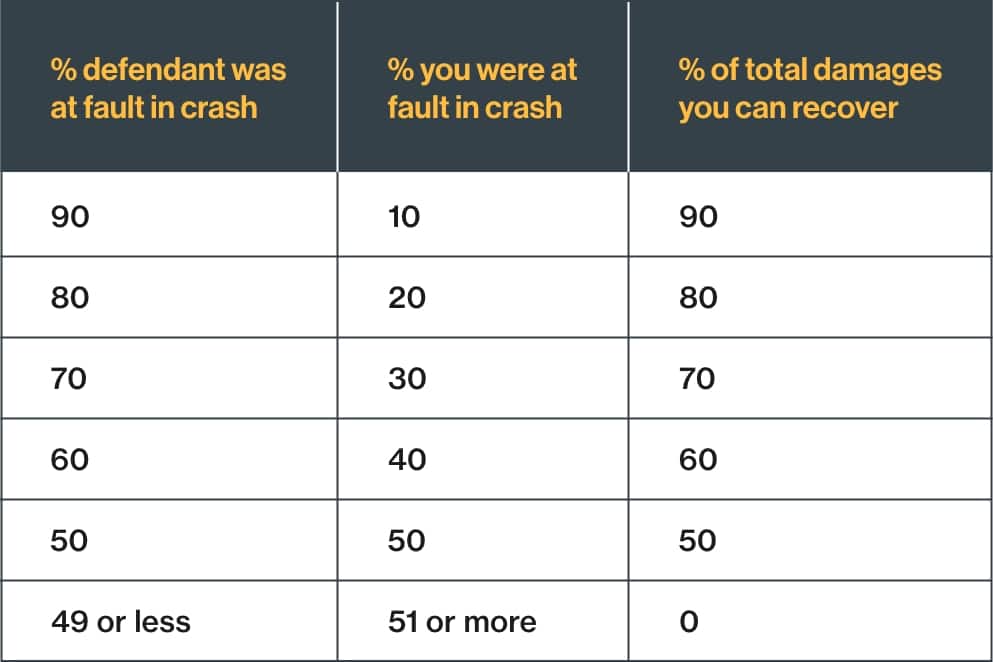
Texas negligence laws work the same as comparative negligence for all cases where the other person who injured you (the defendant) is at least 50 percent at fault. But if you were 51 percent at fault or more for causing your injuries, your potential monetary compensation goes down to zero.
Put another way: if you want to file a successful car accident claim in Texas, you and your attorney must prove that the negligent person who injured you in a car crash was at least 50 percent responsible for causing the wreck. If you (the plaintiff) are 51 percent responsible or more, you can’t receive any money at all for your injuries and other losses.
Here’s a table that might make the modified comparative negligence laws in Texas easier to understand.
Contributory Negligence
The alternative to comparative negligence is a different rule called contributory negligence. Under pure contributory negligence, an injured party can’t recover compensation if they were even 1 percent at fault for causing their own injuries.
Pure contributory negligence is a very harsh rule, but fortunately, it doesn’t apply to personal injury claims in Texas. So, if you’ve been injured in Texas, just know that if you read about contributory negligence, this rule doesn’t apply in our state and isn’t relevant to your case.
Joint and Several Liability
One question you might be asking is: What if multiple other people were at fault for causing my injuries? In that case, figuring out who must pay for damages may involve Texas’ rules for joint and several liability.
Under joint and several liability, a defendant in a personal injury case who is 51 percent at fault or more for causing your injuries may be jointly and severally liable. If joint and several liability applies, the defendant who is mostly at fault can be held responsible for all the damages you (the plaintiff) are entitled to.
As an example, let’s say Mike and Jennifer both contributed to the crash that injured you. Mike was 60 percent responsible, and Jennifer was 40 percent responsible.
If joint and several liability applies, you could file a personal injury claim against both Mike (who would owe 60 percent of the damages) and Jennifer (who would owe 40 percent). Or, you could file a claim against Mike for 100 percent of the damages.
So, why does this matter? Well, imagine Mike is a millionaire and Jennifer just filed for bankruptcy. Suddenly, the option to file a claim against Mike alone looks a lot better than trying to collect a chunk of your damages from Jennifer, who is broke.
There is also another, much more rare application of joint and several liability that involves criminal acts. If the defendant was engaged in some type of criminal behavior—like murder, sexual assault, or kidnapping—at the time they caused your injuries, then they can be held fully responsible for the damages no matter what percentage they were at fault.
How Will Comparative Negligence Affect My Texas Car Accident Case?
Even if you understand how Texas comparative negligence works, you still may be wondering: “OK, but what does this mean for my case?”
Comparative negligence affects personal injury cases in lots of complicated ways, but there are a few results of comparative negligence that you can almost always expect after a car crash.
The Insurance Company Will Try to Put the Blame on You
Under comparative negligence, the most straightforward way for the insurance company to get out of paying you fair compensation is to blame you for the accident. As soon as you start talking with the insurance adjuster after a car accident, they will begin looking for ways to pin the crash on you.
The adjuster won’t tell you this, of course—they may tell you they are trying to help or are just looking to get “the facts.” In reality, the only facts the adjuster is interested in are the ones that make you look bad. That’s why after a car crash, you should never talk to an insurance adjuster until you’ve spoken with an experienced personal injury attorney and gotten a free case evaluation.
Expect Lots of Arguing Over Who Is at Fault and to What Degree
Even if the insurance company can’t successfully blame the majority of the car crash on you, they can still pay you less if they can show you were partially at fault for the collision. So, the insurance company and their attorneys will dig up and present any evidence they can possibly use against you. The more blame they successfully place on you, the less they have to pay you.
To fight back against these tactics, it’s critical to work with an experienced lawyer. A good Texas personal injury attorney will know all the strategies and arguments that insurance companies use to blame injured victims, and they will be able to gather essential evidence and present compelling arguments to show the truth about how the defendant caused your injuries.
You and Your Attorney Will Have to Prove the Defendant Was at Least 50 Percent at Fault
Since the amount of compensation you’re eligible to receive depends on how much the defendant was at fault, you and your attorney will have to show how the defendant’s actions caused the crash that injured you. And it will be very important to show that the defendant was at least 50 percent at fault — because under Texas’ modified comparative fault rule, if you (the plaintiff) are 51 percent at fault or more, then you have no case.
Texas has very specific rules about what goes into showing that a defendant is at fault and liable. To prove negligence, you and your lawyer will need to show that five legal elements are present in your case:
- Duty of care: The defendant had a duty to act (or not act) in a certain way to ensure the safety of those around them. This element is usually the easiest to prove. For example, everyone who drives a car has a duty to drive safely and be free of distractions, intoxication, and other factors that could endanger others on the road.
- Breach of duty: The defendant did something—or failed to do something—that violated their duty to look out for others. As an example, a person texting on their cell phone while driving is committing a breach of duty.
- Cause in fact: The defendant’s negligence caused your injuries. So, in this example, the defendant’s texting and driving directly caused them to crash into your vehicle and injure you.
- Proximate cause: The defendant should have known that their actions could create a danger to others. In the case of texting while driving, most reasonable people know that it’s dangerous thanks to years of public service messaging and stories of distracted-driving crashes.
- Damages: You (the plaintiff) suffered actual harm that the legal system can address with monetary compensation. Medical bills for surgery, treatment, and physical therapy after a car crash are an obvious example of damages, although there are many other types of damages—including lost wages, chronic pain, emotional trauma, etc.
Will Adams Law Firm Fights for Injured Accident Victims in Katy, Texas
As a team of attorneys whose families have lived in the Katy, Texas area for generations, we know how important it is to build community. We realize that most people here don’t think of themselves as the “suing type” and may hesitate to file a lawsuit against a neighbor or member of their community. Remember that in most negligence cases, it’s the insurance company who will be paying the damages — not the individual.
You can count on our team of personal injury lawyers to fight for you but also represent you with professionalism and compassion. We’re here to provide the support you need and get you the compensation you deserve.
To schedule your free consultation with a compassionate attorney from our team, call us at (281) 371-6345 or use the easy contact form on our website.
The content provided here is for informational purposes only and should not be construed as legal advice on any subject.
 When you file a bicycle accident claim, do not enter conversations about the incident with an insurance representative. Simply provide the police report and complete necessary forms. Any discussion beyond that puts you at risk of saying something they may try to use against you.
 Beyond negotiations, the circumstances of your case may complicate the process. For example, a significant portion of bicycle accident claims involve a driver who fled the scene. How are you supposed to focus on getting better when you aren’t even sure where to file a claim?
 As you can see, the potential for complications in your bike accident case are numerous. If your injuries are serious, you and your family could wind up spending countless hours trying to figure out the best path forward, all the while inhibiting physical and mental healing.
 A lawsuit is what happens when a personal injury claim or dispute becomes a legal matter within a court of law. It is a formal, defined process that helps bring the dispute toward a conclusion when the parties haven’t yet found a way to come to an agreement.
 Beyond being a formal legal proceeding, lawsuits are helpful for complicated claims. Often, traffic crash cases are more complex than one at-fault driver and one injured person settling a dispute. With the civil court overseeing your case, you and your lawyer have more leverage for a thorough investigation.
 The answer depends on whether you are in a no-fault state or an at-fault state. Texas is a tort state, which means the at-fault driver’s insurance should cover the costs of the accident and medical care (and that the answer to the question in this post’s title is “no.”).
 If you’re wondering what the difference is between an at-fault state and a no-fault state, we can start by telling you that it’s rather significant.
 If you’ve been in an accident, and you are not at fault, you need to get the other driver’s insurance information. Then you can file a claim with the insurance company of the at-fault party.
 At Will Adams Law Firm, our staff has over 25 years of experience in defending the rights of people like you. We talk to auto accident victims daily to learn about the selfish and distracted drivers that put them in harm’s way. If you are struggling to find justice as the victim of a car accident, take advantage of our free consultation to tell us your story and let us see how we can help you receive the fair treatment you deserve.
 If you experienced injuries after a car accident caused by a negligent driver, make sure you get all the medical attention you need. Shoulder injuries, such as a rotator cuff tear, are common during vehicle collisions and can be slow to heal.
 Your shoulder is one of the weaker joints in your body, which makes it more likely to suffer an injury. During a car accident, you may experience unexpected high forces on your muscles, tendons, ligaments, and bones, which can cause these important parts to strain, tear, fracture, or break.
 If you were a passenger in the vehicle of a friend or family member, you may be hesitant to seek a shoulder injury case against someone who is important to you. However, it is not your friend or loved one who will pay for your bills. It is their insurance company – most likely their auto policy, but there are other insurance companies that may cover the settlement.
 Car accidents can and frequently do cause herniated disc injuries. If you’re experiencing symptoms of a herniated disc following a car accident, you shouldn’t ignore the pain. Make sure to see a doctor immediately and carefully follow their treatment plan.
 The spine is a very complex and important structure that stretches from your neck to your lower back. Your spine consists of bones called vertebrae, a spinal cord full of nerves, and many other components like muscle that help hold everything in place. Your spine also contains discs, which are small cushions between the vertebrae that keep the spinal bones from pushing on each other.
 Because the spine is so complex and so vital to the human body, spinal injuries are often very complex as well. And the symptoms of a spinal injury can be very hard to predict.
 Many factors affect how much compensation you can recover in a personal injury claim. A herniated disc can have a wide range of treatment options and outcomes that affect the costs involved. In general, the more severe your injury and the more extensive your medical treatment, the more compensation you can potentially recover.
 If you were involved in a car accident with an Amazon delivery driver, you may have questions about whether Amazon is liable for your lost wages, medical bills, and pain and suffering. However, the answer will vary depending on your situation.
 So, how do you ensure that you get the compensation and answers you deserve after an Amazon delivery truck accident? Regardless of who was at fault, or who was involved in the auto accident, it is very important to follow these steps.
 While people should consult with a personal injury lawyer after any car accident, this is especially true after a wreck with an Amazon delivery driver. An attorney can help you identify each and every insurance policy that covers your claim, document your injuries, and calculate your losses.
 In Texas, failure to yield while turning left was the fifth most common accident cause in 2021, followed by failure to yield at a stop sign as the sixth. This is because many drivers roll through stop signs, speed through intersections, and make improper left turns.
 If you or someone you love is involved in a failure to yield crash, you can take some simple steps to protect your family.
 Someone who does not yield the right of way might face both civil and criminal sanctions. First, simply failing the yield the right of way is a Class C misdemeanor in Texas, and you might face fines, points on your license, and other criminal penalties.
 Often, the at-fault driver will try to avoid taking responsibility when a collision occurs. The police report of the accident will carry weight with insurance companies, so if the police believe the other driver is not at fault, you may struggle to receive the right help with auto repairs, medical bills, and more.
 Humans get distracted easily, and in multiple ways. But when you’re behind the wheel, staying focused on the task at hand is crucially important.
 As we said in the beginning, driving while distracted is a frequent cause of car accidents, injuries, and deaths. Unfortunately, it’s generally difficult to prove, especially without the help of an attorney.
 The last thing you need as you heal is a legal battle that feels like a wild goose chase, which can happen if you try handling the early stages of a motorcycle accident case yourself.
 The minimal protection motorcycles offer leaves bikers vulnerable to other vehicles and the road itself. Too often, this means catastrophic injuries, such as traumatic brain injuries (TBIs), paralysis, or even death following a motorcycle accident.
 Insurance companies can tell when an injured person is pursuing compensation on their own, without the help of legal representation. Adjusters are trained to close claims as quickly and cheaply as possible, and the situations above help them do so, especially if you aren’t fully prepared to fight back.