
Why Drunk Driving Accidents Rise During the Holidays

The holiday season in Texas should be a time of warmth, family, and celebration. Yet, for too many families, these festive moments are shattered by the flashing lights of an ambulance and the devastating consequences of an impaired driver. Your holiday celebration, planned for weeks, can be turned into a life-altering tragedy in a single instant on a highway like I-10 or a local road in Katy. The unfortunate truth is that the period from Thanksgiving to New Year’s Day is one of the most dangerous times to be on Texas roads, precisely because of an increase in drunk driving.

The Sobering Statistics: A Look at Holiday Driving in Texas

The numbers paint a grim picture. While drunk driving is a year-round epidemic, the holiday season sees a distinct and measurable spike. The Texas Department of Transportation (TxDOT) runs annual campaigns like “Drive Sober. No Regrets.” for a reason.

  • Statewide Impact: In a recent year, Texas recorded 126 deaths and 272 serious injuries in drunk driving crashes just during the holiday period from Thanksgiving to New Year’s Day.
  • A Tragic Ratio: On average, about 25% of all traffic fatalities in Texas are alcohol-related. During the holiday season, that number tragically rises to 28%.
  • The Lasting Streak: A powerful and somber reminder from TxDOT’s #EndTheStreakTX campaign is that November 7, 2000, was the last deathless day on Texas roadways. Every day since, someone has lost their life on a Texas road, with impaired driving being a major contributor.
  • National Problem, Texas Focus: Texas consistently leads the nation in the total number of alcohol-related driving fatalities. When celebrations increase, so does this tragic statistic.

What Defines “Drunk Driving” Under Texas Law?

To understand the problem, it is important to know the legal definition. In Texas, the criminal offense is “Driving While Intoxicated,” or DWI.

  • Per Se Intoxication: A person is considered legally intoxicated per se (by law) if they have a blood or breath alcohol concentration (BAC) of 0.08% or higher. For commercial drivers, this limit is 0.04%.
  • Impairment Definition: A driver can also be arrested and charged with a DWI even if their BAC is below 0.08%. Texas law defines “intoxicated” as “not having the normal use of mental or physical faculties by reason of the introduction of alcohol, a controlled substance, a drug, a dangerous drug, a combination of two or more of those substances, or any other substance into the body.”
  • Implied Consent: Texas has an “implied consent” law. This means that by operating a motor vehicle on a public road, you have automatically consented to a chemical test (breath or blood) if you are lawfully arrested for a DWI. Refusal to submit can lead to an automatic driver’s license suspension.

Why Do These Tragic Collisions Spike During the Festive Season?

The reasons for the holiday spike are a combination of social, cultural, and environmental factors. It is a “perfect storm” of conditions that lead to more impaired drivers on the road.

  • Increased Social Gatherings: The holiday season is packed with events where alcohol is served. This includes office parties, neighborhood get-togethers, family dinners, and New Year’s Eve celebrations.
  • The “Friend’s House” Factor: A TxDOT survey revealed a significant insight: a majority of Texans who admitted to driving after drinking said they had done so after being at a friend’s house. This suggests a level of comfort and a false sense of security that is different from being at a public bar.
  • Higher Rates of Alcohol Consumption: From celebratory toasts to traditional holiday drinks, alcohol consumption in general increases during this period. Binge drinking, in particular, is more common at holiday parties.
  • Increased Travel and Road Congestion: More people are on the road, traveling to see family or attend events. This congestion on major highways like the Grand Parkway or I-10 increases the odds of any accident, and the presence of impaired drivers makes that risk far more deadly.
  • Holiday-Related Stress and Emotions: For some, the holidays are a source of stress, depression, or loneliness. This can lead to self-medicating with alcohol and making poor decisions, like getting behind the wheel.
  • Late-Night Celebrations: Many holiday parties, especially on New Year’s Eve, go late into the night. This means more drivers are on the road during the most dangerous hours (between midnight and 3 a.m.) when visibility is low, drivers are fatigued, and impairment rates are highest.

Which Holidays Are Most Dangerous on Texas Roads?

While the entire period from late November to early January is high-risk, some days stand out as particularly dangerous.

  • Thanksgiving Eve: Often called “Blackout Wednesday,” this is one of the biggest drinking nights of the year as college students return home and friends gather before the family holiday.
  • New Year’s Eve and Day: This is statistically the most dangerous holiday for alcohol-related fatalities. Celebrations are centered around alcohol and continue past midnight, putting impaired drivers on the road at the same time as others are heading home.
  • Christmas: While often seen as a family-focused holiday, the days surrounding Christmas also see an increase in parties and social drinking, leading to a higher risk of DWI crashes.
  • Other “Party” Holidays: It is worth noting that other celebration-focused holidays, such as the Fourth of July, Memorial Day, and Labor Day, also see significant spikes in impaired driving collisions.

What Makes a Drunk Driving Accident Claim Different from a Standard Car Wreck Case?

If you are hit by a drunk driver, the resulting civil claim is fundamentally different from a standard collision caused by simple distracted driving.

Parallel Criminal and Civil Cases: There are two separate cases that happen at the same time:

  • The Criminal Case: The State of Texas (prosecutor) versus the drunk driver. The goal is to punish the driver with fines, license suspension, and potential jail time.
  • The Civil Case: The victim (you) versus the drunk driver (and other liable parties). The goal is to recover financial compensation for your injuries, property damage, and other losses.

The Power of a Guilty Plea: The outcome of the criminal case can be powerful evidence in your civil claim. If the driver pleads guilty to DWI, it becomes very difficult for them to deny liability for the collision in your civil lawsuit.

The Potential for Exemplary (Punitive) Damages: In a typical car accident claim, you can only sue for compensatory damages (like medical bills and pain and suffering). In a drunk driving case, Texas law allows victims to pursue exemplary damages (also known as punitive damages). These are designed to punish the drunk driver for their gross negligence and to deter similar conduct in the future. This can substantially increase the value of a claim.

Who Can Be Held Liable for a Drunk Driving Accident in Texas?

A common mistake is assuming the intoxicated driver is the only party who can be held responsible. In Texas, the law may allow you to seek compensation from other parties who contributed to the driver’s intoxication.

The Intoxicated Driver: This is the most obvious liable party. Their auto insurance is the primary source of recovery, but their personal assets may also be at stake, especially if exemplary damages are awarded.

Commercial Establishments (Texas Dram Shop Act): This is a very important area of Texas law. The Texas Dram Shop Act (found in the Texas Alcoholic Beverage Code) allows a victim to hold an alcohol provider liable if:

  • The provider (a bar, restaurant, or store with a liquor license) sold or served alcohol to the driver; and
  • At the time they were served, it was “apparent to the provider” that the person was “obviously intoxicated to the extent that he presented a clear danger to himself and others.”
  • The intoxication of that person was a “proximate cause” of the damages suffered.

Social Hosts (A Key Distinction): What about the office party or the friend’s house? Texas law is different for “social hosts” (private individuals not selling alcohol).

  • Serving Adults: Generally, a social host is not liable for injuries caused by an adult guest they served, even if that guest was obviously intoxicated.
  • Serving Minors: There is a major exception. A social host can be held liable if they are 21 years of age or older and they knowingly serve alcohol to a minor (under 18), or knowingly allow a minor to be served on their property, and that minor’s intoxication causes a crash.

What Types of Compensation Can Victims Pursue?

The goal of a civil claim is to make the victim “whole” again, though no amount of money can undo the trauma. The compensation, or “damages,” is intended to cover every loss you have suffered.

Economic Damages (Compensatory):

  • Medical Expenses: All costs from the moment of the crash, including ambulance rides, emergency room care, hospital stays, surgeries, physical therapy, and any future medical care.
  • Lost Wages: Income lost from being unable to work during recovery.
  • Loss of Earning Capacity: If the injury is permanent and prevents you from returning to your previous job or working at all.
  • Property Damage: The cost to repair or replace your vehicle and any other property destroyed.

Non-Economic Damages (Compensatory):

  • Pain and Suffering: Compensation for the physical pain and emotional distress of the injury.
  • Mental Anguish: For the fear, anxiety, depression, and trauma resulting from the collision.

Exemplary (Punitive) Damages:

  • As mentioned, these damages are intended to punish the drunk driver for their gross negligence. This is a key element in drunk driving cases that is not available in most other personal injury claims.

What Immediate Steps Should You Take After a Collision with a Suspected Drunk Driver?

Your actions in the minutes and hours after the crash can have a significant impact on your health and your future legal claim.

  • Call 911 Immediately: Report the accident and inform the dispatcher that you suspect the other driver is intoxicated. This is the most important step.
  • Move to Safety (If Possible): If your car is operational, move it to the side of the road to avoid being hit again. If you cannot move the car, turn on your hazard lights.
  • Do Not Confront the Driver: Impaired individuals can be unpredictable and aggressive. Stay in your vehicle if it is safe, or keep a safe distance. Let the police handle the interaction.
  • Observe and Document: While waiting for help, try to observe the other driver’s behavior. Are they stumbling? Slurring their words? Trying to hide containers? Note your observations and any statements they make.
  • Get Witness Information: If other people stopped, get their names and phone numbers. Their independent testimony can be invaluable.
  • Take Photos and Videos: Safely document the accident scene, the damage to both vehicles, the license plates, and any visible evidence of alcohol (like open containers).
  • Seek Medical Attention: Even if you feel fine, you must get a medical evaluation. Adrenaline can mask serious injuries. This also creates a medical record linking your injuries to the crash.
  • Do Not Give a Recorded Statement: The other driver’s insurance company will call you. Do not provide a recorded statement or accept a quick settlement offer. Politely decline and state that you will be speaking with an attorney.
  • Preserve Evidence: Do not repair your vehicle until your attorney has had a chance to have it inspected and the evidence documented.

How a Knowledgeable Drunk Driving Accident Attorney Can Help

Navigating the aftermath of a DWI crash alone is overwhelming. The at-fault driver’s insurance company has a team of adjusters and lawyers working to minimize their payout. A trial attorney dedicated to these cases works to level the playing field.

A knowledgeable attorney will:

  • Act Immediately: Send spoliation letters to the at-fault driver, their insurance, and any potential dram shop defendants to preserve critical evidence like video footage, receipts, and driver records.
  • Manage All Communications: Handle all contact with insurance companies so you can focus on your recovery.
  • Conduct a Thorough Investigation: Obtain the police report, toxicology results, witness statements, and 911 call logs.
  • Identify All Liable Parties: Investigate whether a bar, restaurant, or other provider has liability under the Texas Dram Shop Act.
  • Build Your Damages Case: Work with your doctors, medical experts, and financial planners to calculate the full, long-term cost of your injuries, not just your current bills.
  • Navigate the Legal Process: File all necessary legal documents, handle negotiations, and, if necessary, present your case to a jury in Harris or Fort Bend County.

Contact Our Katy, TX Truck Accident Law Firm Today

You should not have to bear the financial, physical, and emotional burden of a drunk driver’s reckless decision. The holiday season is a time for family, and when that peace is broken by negligence, you deserve a dedicated advocate to fight for you. The Will Adams Law Firm is prepared to take immediate action to protect your rights and secure the evidence needed to build a strong case.

If you or a loved one has been injured in a collision caused by an impaired driver, contact us today at (281) 371-6345 for a free and confidential consultation. We are here to listen to your story and explain your legal options.

Understanding the Statute of Limitations in Texas Car Crash Cases

Of all the concerns that flood your mind after a serious car crash—the flashing lights, the hospital visits, the uncertainty about your injuries—a legal deadline is likely the last thing you are thinking about. Your focus is on recovery, on figuring out how to pay the bills, and on putting the traumatic event behind you. Yet, in the background, a clock is ticking. It is a non-negotiable legal countdown that can ultimately determine whether you can ever recover compensation for your losses.

At Will Adams Law Firm, we have seen how the chaos following a fatal car crash in Katy, TX can cause even the most diligent people to overlook these critical timelines. As a trial law firm rooted in the Katy, Texas community, we understand the local roads, the courts, and the complexities of the law. Our work is dedicated to managing the legal burdens, like the statute of limitations, so our clients can concentrate on what matters most: healing and rebuilding their lives.

What Exactly Is a Statute of Limitations?

In the simplest terms, a statute of limitations is a law that sets a firm time limit on your right to file a lawsuit against another party. Think of it as a countdown clock established by state law. Once that clock runs out, your legal claim effectively expires, and you lose the right to seek justice through the court system, regardless of how strong your case might have been.

These laws exist for several practical reasons:

  • To Preserve Evidence: Over time, evidence degrades. Witnesses’ memories fade, they may move away, or they might pass away. Physical evidence like skid marks disappears, and electronic data from vehicles can be erased. A deadline encourages prompt action while evidence is still fresh and reliable.
  • To Prevent Endless Uncertainty: Without a deadline, a person or company could live under the threat of a lawsuit indefinitely. Statutes of limitations provide a point of finality, allowing parties to move forward.
  • To Ensure Fairness: It is considered fundamentally unfair to force a defendant to defend against a claim from the distant past when the ability to gather evidence and present a defense has been compromised by time.

While these reasons are logical, the reality for an injured person is that the statute of limitations can feel like an unforgiving and arbitrary barrier, especially when you are focused on recovering from serious injuries.

What Is the Deadline for a Car Accident Lawsuit in Texas?

For most personal injury cases arising from a car accident in Texas, the statute of limitations is two years.

This two-year period is established by the Texas Civil Practice and Remedies Code § 16.003. The clock typically starts running on the date the accident occurred. This means you have exactly two years from the day of the crash to formally file a lawsuit in a Texas court.

Missing this deadline has severe and irreversible consequences. If you attempt to file a lawsuit even one day after the two-year period has expired, the at-fault driver’s attorney will file a motion to dismiss your case, and the judge will almost certainly grant it.

If you miss the deadline:

  • You lose all legal right to sue the negligent party for your injuries.
  • Your ability to seek compensation for medical bills, lost wages, and pain and suffering is permanently lost.
  • The at-fault driver’s insurance company will have no legal or financial incentive to continue negotiating with you, and they will close your claim without payment.

It is not an exaggeration to say that this is one of the most critical deadlines in the entire civil justice system.

Are There Exceptions That Can Change the Two-Year Deadline?

While the two-year rule is strict, Texas law recognizes that certain circumstances can make it impossible or unfair to start the clock on the date of the accident. These exceptions can “toll” or pause the statute of limitations, but they are specific and narrowly applied.

The Discovery Rule

Sometimes, an injury is not immediately apparent. You might walk away from a crash on the Grand Parkway feeling sore but not seriously hurt, only to be diagnosed months later with a herniated disc or a traumatic brain injury with delayed symptoms. In these situations, the Discovery Rule may apply. This rule states that the two-year clock does not begin to run until the date you knew, or reasonably should have known, that you were injured and that your injury was likely caused by the accident. This is a complex legal argument that requires careful presentation of medical evidence.

Tolling for a Minor

When a child under the age of 18 is injured in a car accident, the statute of limitations is tolled. The two-year countdown does not begin until the child’s 18th birthday. This means a person injured as a minor generally has until their 20th birthday to file a lawsuit.

The Victim Is of “Unsound Mind”

If a person is rendered legally incapacitated by their injuries—for example, they are in a coma or have suffered a severe TBI that prevents them from managing their own affairs—the statute of limitations can be paused. The clock will not begin to run until their legal disability is removed (i.e., they regain mental capacity).

The At-Fault Party Leaves Texas

If the person who caused the accident leaves the state of Texas for any period of time after the crash, the law may pause the clock. The time they are absent from the state might not count toward the two-year limit, as their absence prevents you from legally serving them with the lawsuit.

Fraudulent Concealment

In rare cases where the at-fault party takes active steps to hide their identity or their involvement in the crash, the statute of limitations can be tolled. The clock would only start once their identity is discovered.

How Does the Deadline Apply to Different Types of Claims?

The two-year rule is a general guideline, but the specific type of claim you are filing can have its own unique timeline and procedural requirements.

Wrongful Death Claims

If a car accident results in a fatality, the surviving family members may have a wrongful death claim. The statute of limitations for a wrongful death lawsuit is two years from the date of the person’s death, which may be different from the date of the accident. This distinction is vital. Under Texas law, only the surviving spouse, children, and parents of the deceased are eligible to file this type of claim.

Claims Against a Government Entity

This is one of the biggest traps in Texas injury law. If your accident was caused by a government employee—such as a City of Katy employee driving a city vehicle, a Harris County road maintenance crew, or a state-owned vehicle—you are bound by the Texas Tort Claims Act. This Act requires you to provide a formal “notice of claim” to the correct government unit long before the two-year statute of limitations for filing a lawsuit is up.

  • Notice Deadlines: These notice periods are incredibly short, often as little as 90 or 180 days from the date of the accident, depending on the specific government entity.
  • Strict Requirements: The notice must be in writing and contain specific details about the incident.
  • Consequences of Failure: Failing to provide this formal notice within the short timeframe can completely bar your right to ever file a lawsuit, even if you are well within the two-year statute of limitations.

Property Damage Claims

The claim for damage to your vehicle also has a two-year statute of limitations. While it runs on the same timeline as your injury claim, it is technically a separate claim. Often, the property damage portion of a case is resolved much more quickly than the personal injury component.

Why You Should Never Wait Until the Deadline Approaches

Even though the law gives you two years, waiting until the final months, weeks, or days to act is a significant strategic mistake that can jeopardize your case. An effective legal claim is not built overnight.

  1. Evidence Vanishes Quickly. In the days and weeks after a crash, critical evidence can be lost forever. Dashcam or security camera footage from nearby businesses is often deleted on a 30-day loop. Witnesses move or their memories become unreliable. The physical condition of the vehicles and the accident scene changes. A thorough investigation must begin immediately.
  2. A Proper Investigation Takes Time. Building a strong case requires more than just the police report. It involves obtaining all medical records, interviewing witnesses, sending evidence preservation letters to trucking companies, and potentially hiring accident reconstructionists to analyze the physics of the crash. This process takes considerable time.
  3. The Full Extent of Injuries Must Be Understood. It can take months to determine the true nature of your injuries and what future medical care you will require. Settling a claim or filing a lawsuit before you have a clear prognosis from your doctors is risky, as you may not account for future surgeries, therapies, or long-term disabilities.
  4. Insurance Negotiations Require Leverage. Insurance adjusters are aware of the statute of limitations. As the deadline approaches, they know your options are shrinking. The most powerful leverage you have in negotiations is the credible threat of filing a lawsuit. To do that, your attorney needs ample time to prepare the case for court before the deadline expires.
  5. Legal Procedures Are Time-Consuming. Drafting a formal lawsuit (known as a petition), ensuring all responsible parties are named correctly, filing it with the appropriate court, and legally “serving” the paperwork on the defendants are all detailed legal steps that cannot be rushed. A mistake in this process can have serious consequences.

Common Misconceptions About the Filing Deadline

Many injured individuals fall victim to misunderstandings about how this critical deadline works, often due to misleading information from insurance adjusters.

Misconception #1: “Negotiating with the insurance company pauses the clock.”

Reality: This is dangerously false. Talking to an insurance adjuster, sending them documents, or negotiating a settlement does not stop the two-year statute of limitations from running. Some adjusters may intentionally drag out negotiations, knowing that if you pass the deadline, their obligation to pay disappearsMisconception #2: “I already filed an insurance claim, so I’m protected.”

Reality: An insurance claim is an administrative process with a company. A lawsuit is a formal legal action filed with a court. Filing an insurance claim does nothing to satisfy the statute of limitations. You must file a lawsuit in court to protect your rights.

Misconception #3: “The deadline is just a suggestion and can be extended.”

Reality: The statute of limitations is a hard-and-fast legal rule. The exceptions are rare and apply only in very specific situations. For the vast majority of cases, once the two-year mark passes, the door to the courthouse is permanently closed.

Let Us Watch the Clock, So You Can Focus on Recovery

Navigating a serious injury is difficult enough without the added pressure of complex legal deadlines. Understanding and meeting these timelines is not something you should have to worry about while attending doctors’ appointments and trying to get your life back on track. Protecting your legal rights requires prompt and decisive action.

The team at Will Adams Law Firm is dedicated to taking on these burdens for our clients. We meticulously manage all deadlines, conduct immediate and thorough investigations, and build a trial-ready case from day one. This proactive approach ensures your rights are preserved and sends a clear message to the insurance company that we are prepared to see the case through to the end. If you have been injured in a car crash in Katy or the surrounding areas, do not let time run out on your right to justice.

Contact the Will Adams Law Firm at (281) 371-6345 for a free and confidential consultation. Let us handle the legal fight while you focus on your recovery.

Barratry Offenses in Texas: How Unethical Lead-Gen Companies Exploit Accident Victims

In the disorienting days after a serious car wreck in Texas, your world shrinks. It becomes a blur of doctor’s appointments, calls from your insurance company, and the overwhelming stress of figuring out how to move forward.

Then, your phone buzzes with a text from a number you don’t recognize: “We saw you were in an accident. We can get you a doctor and a lawyer today.” Soon after, the phone rings. A stranger on the other end says they’re from a “claims processing group” and need to send a representative to your house immediately to sign some forms.

This experience is jarring, invasive, and deeply unsettling. It feels wrong because it is wrong. This predatory practice of illegally soliciting accident victims is called barratry, and it is a crime in Texas. It is a scheme often run by sophisticated and unethical lead-generation companies that partner with certain law firms to exploit injured people at their most vulnerable.

What is Barratry Under Texas Law?

In Texas, barratry is the illegal and unethical act of soliciting a potential client for legal services when you have no prior relationship with them. It’s the legal term for what is commonly known as “ambulance chasing.” The law is designed to shield individuals who have just experienced a traumatic event from being pressured, harassed, and manipulated into legal agreements.

The specific statute governing this offense is Texas Penal Code § 38.12. This law makes it a crime for a lawyer or anyone acting on their behalf (like a “case runner” or a lead-generation company) to engage in solicitation through in-person contact or by phone, email, or text.

Under the law, an act of barratry includes:

  • Unsolicited Contact: Directly contacting a potential client or their family member regarding a specific accident or event for the purpose of securing a professional services contract.
  • Using Middlemen: Knowingly financing or paying a “case runner,” lead-generation service, or other non-lawyer to illegally solicit clients.
  • Paying for Referrals: Giving money or anything of value to individuals like police officers, hospital employees, tow truck drivers, or medical staff in exchange for a client referral.

The purpose of this law is clear: your decision to hire an attorney should be a calm, considered choice you make, not a reaction to a high-pressure sales pitch from a stranger who illegally obtained your information.

The Modern “Ambulance Chaser”: How Unethical Lead-Generation Schemes Work

The image of a lawyer handing out business cards at an accident scene is outdated. Today’s barratry schemes are often sophisticated, data-driven operations that treat injured people like profitable leads to be bought and sold.

This predatory ecosystem involves several key players:

  1. The Unethical Law Firm: A firm that, instead of building a reputation through ethical advertising and client results, chooses to buy cases from a lead-generation company.
  2. The Lead-Generation Company: The central hub of the operation. This company creates a network to illegally obtain accident victim information and employs callers or “case runners” to make contact.
  3. The Case Runners: These are the individuals on the front lines. They are the ones who get paid to acquire the victim’s information and pressure them into signing a contract with the law firm that bought the “lead.”

How Do They Get Your Private Information?

After a wreck on I-10 or a local street in Katy, you might wonder how these strangers got your name and phone number so quickly. They do it through a variety of unethical and often illegal methods:

  • Illegally Obtaining Accident Reports: While accident reports are public records, there are rules about their commercial use. These companies often obtain them improperly to harvest personal contact information.
  • Paying Inside Sources: Their networks often rely on paying off insiders for information. This can include bribing hospital staff for patient admission details, tow truck drivers for vehicle owner information, or even rogue police or administrative staff for early access to crash reports.
  • Using Digital Scanners and Monitoring: They monitor police and emergency radio frequencies to learn of accidents in real-time and dispatch runners to the scene or the hospital.

What Do Their Predatory Tactics Look Like?

Once they have your information, the harassment begins. Their goal is to get you to sign a legal representation contract as quickly as possible, before you have a chance to think clearly or speak to anyone else.

  • Relentless Contact: They will bombard you with cold calls, text messages, and emails. In the most egregious cases, a “runner” may show up uninvited at your home or even in your hospital room.
  • Deception and Misrepresentation: They will rarely admit they are from a law firm. Instead, they use deceptive language, claiming to be from “Client Services,” an “Insurance Claims Department,” or a “Medical Assistance Group” to gain your trust.
  • High-Pressure Sales Pitches: They create a false sense of urgency. They might tell you that you will lose your rights or forfeit insurance benefits if you don’t sign with them immediately. This is a deliberate lie designed to scare you into a hasty decision.
  • Offering Improper Incentives: They may offer you an upfront cash “loan” or promise to pay your medical bills, with the condition that you sign a contract with their preferred law firm.

The Dangers of Engaging with Unethical Solicitors

Falling victim to a barratry scheme can cause significant harm to both your legal case and your personal well-being. The firm that has to buy its cases this way is often not the one you would choose after careful research.

Risks to Your Legal Claim:

  • Poor Quality Representation: A law firm that relies on illegal solicitation may not have the skill, resources, or trial experience to handle a serious injury case. They may see you as a commodity to be processed, not a client to be represented.
  • A Rush to a Lowball Settlement: The business model of many of these firms is based on volume and quick turnover. They have an incentive to settle your case as fast as possible for whatever the insurance company offers, often before the full extent of your injuries and future medical needs are even known.
  • Conflict of Interest: The lawyer’s primary loyalty might be to the lead-generation company they have to pay, not to you. This can compromise their professional judgment and their duty to act in your best interest.

Personal Harm to You and Your Family:

  • Loss of Autonomy: You are robbed of your fundamental right to choose your own attorney. This decision should be yours alone, based on your own research and comfort level with a firm.
  • Increased Emotional Distress: The last thing you need while recovering from a traumatic injury is to be harassed by strangers. This predatory contact is an invasion of your privacy that adds immense stress and anxiety to an already devastating situation.
  • Financial Injury: Being locked into a contract with an unqualified firm can ultimately cost you hundreds of thousands of dollars in compensation that you rightfully deserve for your medical bills, lost income, and suffering.

Know the Difference: Legal Advertising vs. Illegal Barratry

It is important to understand the bright line that separates ethical marketing from illegal solicitation.

Legal & Ethical Advertising

  • What it looks like: TV commercials, radio ads, billboards, websites, and search engine ads.
  • The key principle: The communication is public and directed at a general audience. The law firm provides information, and you, the potential client, must initiate the contact. The power is entirely in your hands to decide if and when to call.

Illegal & Unethical Barratry

  • What it looks like: A phone call, text message, email, or social media message you did not request, specifically referencing your recent accident. An uninvited knock on your door from a “legal representative.”
  • The key principle: They initiate direct, unsolicited contact with you. They are actively pursuing you, often using illegally obtained information and high-pressure tactics.

The Golden Rule: A reputable, ethical lawyer or law firm in Texas will never contact you out of the blue after an accident.

Penalties for Barratry and Remedies for Victims

Texas law treats barratry as a serious offense with significant consequences for the perpetrators and powerful remedies for the victims.

Criminal Penalties for the Solicitor:

  • A first-time barratry offense is a Class A Misdemeanor, punishable by up to a year in jail and a fine.
  • A subsequent offense is a third-degree felony, carrying a potential prison sentence.

Your Rights as a Victim of Barratry:

You are not powerless against these predators. Texas law allows you to file a civil lawsuit against the lawyer, the lead-generation company, and anyone else involved in the illegal solicitation scheme. You can seek:

  • A $10,000 statutory penalty for each illegal communication.
  • Recovery of any actual financial damages you suffered as a result of the scheme.
  • Payment of your attorney’s fees for having to bring the barratry lawsuit.

What to Do If You Are a Victim of Barratry

If you are being harassed by unsolicited callers after an accident, here are the steps you should take to protect yourself:

  1. Do Not Engage and Do Not Sign Anything. Do not provide any personal information. Do not answer their questions. If they call, hang up. If they text, block the number. If they come to your door, do not let them in. Under no circumstances should you sign any contract or document they present.
  2. Document Everything. Keep a record of the illegal contact. Save screenshots of text messages. Write down the caller’s name, phone number, and the law firm they claim to represent. Note the date and time of the contact. This documentation is crucial evidence.
  3. Report the Conduct. File a formal complaint with the Chief Disciplinary Counsel’s Office of the State Bar of Texas. This is the official agency responsible for investigating and prosecuting attorney misconduct, including barratry.
  4. Consult with an Ethical Law Firm of Your Choosing. Your primary focus should be on your recovery and your injury claim. Speak to a qualified attorney whom you found through your own research or a trusted referral. You can also discuss your rights regarding a potential civil claim against the individuals and companies who illegally solicited you.

Upholding the Integrity of the Legal Profession

The legal profession has a solemn duty to act with integrity and to protect the public. Barratry is a profound betrayal of that duty. At Will Adams Law Firm, we are committed to upholding the highest ethical standards.

We believe our clients in the Katy area and across Texas deserve to be represented by attorneys they choose based on trust, experience, and a proven record of success—not by a firm that has to break the law just to get clients.

Your choice of an attorney is one of the most important decisions you will make after a serious injury. It should be a deliberate choice, not a reaction to fear and pressure.

If you have been injured in an accident and want to understand your legal rights in a professional, no-pressure environment, contact the Will Adams Law Firm today at (281) 371-6345. We are here to provide a confidential consultation to help you make an informed decision that is right for you and your family.

How to Deal with Insurance Adjusters After a Texas Car Accident

The phone rings. In the chaotic days following a car accident, a call from the other driver’s insurance adjuster can feel like a step toward resolution. The voice on the other end is often calm, professional, and full of concern. They ask how you are, express sympathy, and suggest they just need to ask a few questions to process the claim and “get you taken care of.”

This initial interaction is designed to make you feel at ease, but it is a critical moment that can define the outcome of your case. It’s essential to understand that you are not speaking with a neutral party; you are speaking with a trained professional whose primary goal is to protect their company’s financial interests.

At Will Adams Law Firm, we are trial lawyers who have spent decades representing individuals and families in Katy and across Texas. We have seen firsthand how a seemingly innocent conversation with an adjuster can be used to deny a legitimate claim or drastically reduce its value. Because we prepare every case with the expectation that it might go to trial, we understand the insurance company’s playbook from start to finish.

What Is the Insurance Adjuster’s True Objective?

While the title “adjuster” might imply someone who fairly adjusts a claim to its correct value, their role within the corporate structure is fundamentally different. An insurance adjuster is a company representative tasked with resolving claims for the lowest possible cost. Their performance is often measured by how quickly they can close files and how much money they save the company on payouts.

The adjuster is not a neutral referee looking to make a fair call. They are the star negotiator for the opposing team, and their objective is to win. It is important to understand that every question they ask, every piece of paperwork they request, and every offer they make is a strategic move in this negotiation.

The adjuster’s core objectives typically include:

  • Gaining your trust to elicit information. A friendly demeanor makes you more likely to let your guard down and share details that can be used against you.
  • Securing a recorded statement. This allows them to lock you into a single version of events before you’ve had time to think clearly or consult with an attorney.
  • Finding any reason to shift blame. Texas law on proportionate responsibility means that if they can prove you were even partially at fault, they can reduce their payout.
  • Minimizing the severity of your injuries. They will seize on any statement you make that suggests you are not badly hurt, such as “I’m feeling a little better today.”
  • Pressuring you into a quick, lowball settlement. They know you are likely facing financial strain from medical bills and time off work, and they use this to their advantage.
  • Obtaining a blanket medical authorization. This allows them to search through your entire medical history for any pre-existing condition they can use to argue your current injuries are unrelated to the accident.

The Dangers of a Recorded Statement

One of the adjuster’s most common and immediate requests is for a recorded statement. They will frame it as a simple formality to “hear your side of the story.” You are under no legal obligation to provide a recorded statement to the other party’s insurer, and it is almost always a mistake to do so without legal representation.

A recorded statement is not a conversation; it is a tool for the insurance company. Here’s how it can be used against you:

  • Innocent pleasantries are weaponized. Adjuster: “How are you today?” You: “I’m okay, thanks.” In their report, this becomes “The claimant stated they were ‘okay’,” which will be used to argue your injuries are minor.
  • Memory gaps are framed as credibility issues. The aftermath of a traumatic event like a car crash on I-10 or the Grand Parkway is confusing. If you misremember a small detail—the exact time, the sequence of traffic lights—that contradicts the police report, the adjuster will claim your entire account is unreliable.
  • Speculation becomes “fact.” They will ask questions designed to elicit a guess. “Would you say you were going about the speed limit?” or “Do you think the other driver saw you?” Any answer you give can be presented as a concrete admission.
  • Medical downplaying. When asked about your injuries, you might say, “My neck is sore, but I’m managing.” The adjuster hears and notes that you are “managing,” ignoring the underlying pain and potential for a more serious diagnosis like a herniated disc that may not be fully apparent yet.

Instead of agreeing to a statement, you have every right to politely decline. A simple, “I am focusing on my medical care right now and will not be providing a recorded statement at this time,” is a complete and effective answer.

Common Tactics in the Insurance Adjuster’s Playbook

To effectively minimize claims, adjusters employ a range of time-tested strategies. Recognizing these tactics is key to avoiding their pitfalls.

The Aggressively Friendly Approach

This is the most common starting point. The adjuster will be personable, empathetic, and seem genuinely concerned about your well-being. This is a deliberate strategy to build false rapport and make you feel comfortable sharing information you otherwise wouldn’t.

The Low, Fast Settlement Offer

Within weeks, or sometimes even days, a check might be offered. This offer preys on the financial anxiety that follows an accident. It might cover your initial emergency room visit and seem reasonable at first glance. However, these offers are made before the true scope of your injuries is known. Many serious injuries, like soft-tissue damage or spinal conditions, have delayed symptoms.

Accepting this offer requires you to sign a final release. Once signed, you forfeit all rights to seek further compensation for this incident. If you later require surgery, extensive physical therapy, or are unable to work for an extended period, you cannot go back for more. It is a gamble you should not take.

The Blame Game: Using Proportionate Responsibility

Texas operates under a “proportionate responsibility” or “modified comparative negligence” system. This means your ability to recover damages is directly tied to your percentage of fault. If you are found to be 51% or more at fault, you are barred from receiving any compensation. If you are found 20% at fault, your final award is reduced by 20%.

Adjusters are masters at using this rule. They will ask leading questions designed to get you to admit partial fault:

  • “Were you distracted by anything at all before the crash?”
  • “You were in a bit of a hurry to get to work, weren’t you?”
  • “Is it possible you were going a little over the speed limit?”

A simple “I guess so” or “maybe” can be documented as an admission of fault that will be used to reduce or deny your claim.

The Delay and Stall Tactic

If a quick settlement doesn’t work, the opposite tactic could be employed. The adjuster may suddenly become very difficult to reach. Your calls go to voicemail, emails go unanswered, and you’re told they are “still investigating” or “waiting on a supervisor’s approval.” This is often a deliberate strategy. The insurance company knows that as your bills pile up, your desperation will grow, making you more likely to accept a low offer later on.

Misrepresenting the Law or Your Policy

Less scrupulous adjusters may give you incorrect information to discourage you. They might tell you that you don’t need a lawyer, that a certain type of damage isn’t covered, or that you have to use one of their “approved” auto body shops. These statements are often untrue and designed to control the process and limit their costs.

Surveillance

In cases involving significant injuries, it is not uncommon for insurance companies to conduct surveillance. This can include:

  • Online Surveillance: They will scrutinize your social media profiles (Facebook, Instagram, etc.) for photos or posts that contradict your injury claims. A photo of you at a family barbecue could be used to argue you aren’t in as much pain as you claim.
  • Physical Surveillance: In some instances, an investigator may be hired to film you in public, hoping to capture footage of you carrying groceries, mowing the lawn, or doing any activity that could be used to question the severity of your disability.

What to Do (and Not Do) When an Adjuster Calls

Navigating this process requires a clear and disciplined approach.

What You SHOULD Do:

  • Get the adjuster’s information: Write down their name, title, phone number, and the insurance company they work for.
  • Keep it brief and factual: Provide only basic identifying information: your name, address, and phone number.
  • Identify your attorney: The most powerful thing you can do is state, “All future communications should be directed to my attorney.”
  • Document the call: After you hang up, make a note of the date, time, and what was discussed.

What You Should NOT Do:

  • Do not agree to a recorded statement.
  • Do not discuss the facts of the accident or your injuries.
  • Do not guess, speculate, or apologize for anything.
  • Do not accept any settlement offer without legal review.
  • Do not sign any documents, especially a medical authorization form. The adjuster’s form is often a blanket release allowing them access to your entire life’s medical history, not just records relevant to the accident.

How a Katy Car Accident Attorney Changes the Dynamic

Hiring a personal injury attorney immediately shifts the power balance. An adjuster who is used to dealing with individuals who are unfamiliar with the law must now contend with a professional who understands the system, knows the value of a claim, and is not intimidated by their tactics.

Here is how the Will Adams Law Firm specifically levels the playing field:

  • We Take Over All Communication: The moment you retain our firm, we send a formal letter of representation to the insurance company. This legally obligates them to cease all direct contact with you. The harassing calls stop, and you can focus on your recovery.
  • We Conduct Our Own Investigation: We don’t rely on the police report or the adjuster’s version of events. We launch our own independent investigation to establish liability, preserve evidence, and identify all responsible parties.
  • We Accurately Calculate All Your Damages: An adjuster’s offer rarely accounts for the full scope of your losses. We work with your doctors to understand your future medical needs. We may engage economists to calculate your lost earning capacity and life care planners to detail the costs of living with a permanent disability. We build a comprehensive demand package that accounts for every category of your economic and non-economic damages.
  • We Challenge Their “Experts”: Insurance companies often require you to see one of their doctors for a so-called “Independent Medical Examination” (IME). These doctors are chosen and paid by the insurer and often produce reports that favor the company’s position. We know how to prepare you for these exams and, more importantly, how to challenge a biased report in negotiations or in court.
  • We Negotiate with the Power of the Courtroom: This is perhaps the most significant advantage. We are trial lawyers. We work together on our firm’s cases, preparing each one as if it will be presented to a jury. Insurance companies keep records on law firms. They know which firms settle every case cheaply and which ones are willing and able to go to trial and win. Our reputation for being unafraid to go to court means they are more likely to negotiate fairly, knowing a lowball offer will be rejected and there is a much better chance they will have to face a judge and jury.

Contact Our Katy, TX Personal Injury Law Firm Today

The aftermath of a serious car accident is not the time to engage in a high-stakes negotiation with a trained corporate representative. It is a time to focus on your health, your family, and your recovery. Let a team with deep roots in the community and a proven track record of standing up to insurance companies handle the legal battle for you.

At Will Adams Law Firm, we are proud to fight for injured Texans. We understand the tactics, we know the law, and we are prepared to work tirelessly to secure the resources you need to rebuild your life. If you or someone you love has been hurt in a crash, contact our Katy office today at (281) 371-6345 for a complimentary and confidential case assessment.

Why Do I Have a Headache After a Car Accident?

Post-traumatic headaches are one of the most common symptoms following a car accident. Whether caused by the injury itself or just the stress and anxiety of dealing with the aftermath, headache pain is extremely common after even relatively minor crashes.

A woman lying on the couch with a headacheThe good news is that most post-traumatic headache pain is temporary and not a sign of a more serious injury. However, if you’re dealing with constant or frequent headaches for longer periods of time, or if you have especially intense headaches, it might be a sign of a more serious problem.

It’s important to take any painful symptoms seriously after a motor vehicle accident, including headache symptoms. You should never assume post-crash problems will simply go away with time. While many conditions do improve with time, it’s far better to visit a healthcare provider who can identify (and treat) potentially serious injuries as soon as possible.

Possible Causes of Car Accident Headaches

A person speaking with a medical professionalThe sudden and violent jolt of a car accident can injure your head and neck in many ways. Two different crash victims might have similar headache symptoms that come from completely different physical injuries.

Possible headache causes include but are not limited to:

  • Muscle strain. The impact forces of a car accident can overextend, stretch, and sometimes even tear muscles, tendons, and ligaments in the scalp and neck. These injuries can result in tension headaches that are often mild to moderate in severity, come on gradually, and tend to be bilateral (meaning they affect both sides of the head equally).
  • Pinched nerves. Sensory nerves in the head, neck, and spine (such as the greater occipital nerve) are extremely vulnerable in a motor vehicle collision. A pinched nerve in this area can lead to neck pain that radiates forward along the entire pathway of the nerve into the head and forehead. Pinched nerve headaches usually heal on their own in a few weeks to months, but some linger for much longer or require medical treatment to heal.
  • Traumatic brain injury. Headaches are one of the most common symptoms of mild traumatic brain injuries, also known as concussions. Concussion headaches can come and go for months or even longer after the initial injury. Many crash-related concussions go undiagnosed, especially for victims who have other injuries that need urgent or emergency care. While most concussions do heal completely within 3–6 months, more than 25 percent of cases develop into long-term post-concussion syndrome.
  • Fracture headaches. If your head violently collided with an object such as the steering wheel during the crash, the force of that impact might have been strong enough to cause a closed skull fracture. Fracture headaches often feel like migraine headaches and may cause intense pain (especially near the fracture site, although the pain can appear elsewhere too), nausea, and confusion.
  • Emotional stress and anxiety. Even if you didn’t suffer a head injury, the aftermath of an auto accident can be incredibly stressful. Managing medical appointments, calls with the insurance company adjuster, legal proceedings, and more all take a toll on victims. Stress is one of the most common triggers for persistent headaches, including migraines.

What Should I Do if I Have a Headache After a Car Accident?

Seek Medical Attention as Soon as Possible

A woman on the phone holding her headAfter a car accident, you should always seek medical treatment as soon as possible if you experience any noticeable symptoms. Many conditions are associated with delayed symptoms that might not fully emerge until several days or even weeks afterward. Catching them early usually means a better treatment outcome, and early treatment also makes it easier to prove to the insurance company that your headache pain was a direct result of the crash.

Keep in mind that although you may have received emergency medical treatment, the full extent of your injuries might not be known yet. The truth is that head injuries are often missed by emergency care doctors in the immediate aftermath of the crash. This can happen for any number of reasons; maybe the doctor isn’t an expert in traumatic brain injury cases or needed to prioritize more urgent or immediately apparent injuries. Maybe your symptoms just haven’t become obvious yet. And since headaches are both extremely common and usually temporary after car accidents, victims and doctors don’t always take headache symptoms as seriously as they should.

Follow Up If You Notice Any New or Severe Symptoms

Even if an initial evaluation from a doctor or other medical professional did not identify any serious issues, you should seek further medical care if you’re dealing with any of the following after an auto accident:

  • Persistent headaches that don’t go away or frequently come and go
  • Severe headache pain, such as migraine headaches or cluster headaches
  • Nausea (with or without vomiting)
  • Visual disturbances such as halos, flashing lights, or light sensitivity
  • Other sensory disturbances, such as sensitivity to smell or movement)
  • Sleep disorders
  • Slurred speech
  • Brain fog or confusion
  • Anxiety or depression

Any of these symptoms could be a sign that your headaches and other issues might come from a more serious injury, such as a traumatic brain injury.

Contact an Experienced Personal Injury Attorney

If you’re dealing with painful headaches after a car accident, you deserve fair compensation from the at-fault party.

However, headache cases can be challenging to prove to an insurance company or jury. The pain of a headache—or even brain injury symptoms like mood changes or brain fog—isn’t visible to the naked eye, and sometimes the signs of brain injury can even be hard to detect using an MRI or other objective medical test.

Because headache symptoms are often self-reported, insurance companies often accuse innocent accident victims of exaggerating their headache symptoms or blaming pre-existing symptoms on the crash. Successfully countering these claims may require extensive medical records, notes from doctors, statements from colleagues and loved ones, and more.

A personal injury attorney who understands the complexities of headache claims can serve as a huge asset to you as you pursue fair compensation. Even headaches caused by accident-related stress and anxiety can contribute to your overall pain and suffering damages.

Your attorney can help you:

  • Fully investigate the car crash to uncover the truth about what happened and who was responsible. The investigation may include working with accident reconstruction specialists, identifying and preserving camera footage, talking with eyewitnesses, and more.
  • Help you gather the medical records and other evidence you’ll need to prove the severity of your headaches and show the full impact they have had on your life. Without this work, it’s unlikely that the insurance company will provide you with a settlement offer that’s anything close to fair.
  • Negotiate with insurers and medical providers on your behalf. Insurance companies are notoriously difficult for ordinary people to negotiate with, and they use many different tactics to try and pressure victims into giving up their claims or accepting unfair, lowball settlement offers.
  • Handle all other aspects of your legal claim while always answering your questions and keeping you informed about the status of your case.

An experienced attorney can take the challenge and stress out of handling your legal claim and give you the best possible chance at a fair recover—all while allowing you to focus on getting better and being present for your family.

Schedule Your Free Consultation With Will Adams Today

The longer you wait to begin work on your personal injury case, the greater the risk that key evidence gets lost forever, and the more opportunity the insurance company will have to cast doubt on both the cause of the accident and nature of your injuries.

When you seek help from Will Adams Law Firm, your initial consultation is always free, and you won’t owe us anything unless we recover a settlement or verdict on your behalf. Your recovery is our top priority.

To schedule your consultation today, call (281) 371-6345 or fill out the quick contact form on our website.

The content provided here is for informational purposes only and should not be construed as legal advice on any subject.

How Can Texas Comparative Negligence Affect My Case?

A person reviewing information from a car accidentWhen injured victims meet with a car accident lawyer, one of the first questions they often ask is:

“What if the crash was partially my fault? Can I still get compensation for my injuries?”

The short answer to this question is yes—as long as you weren’t more than 50% responsible, that is.

Texas law uses a system called modified comparative negligence for personal injury cases. Comparative negligence says that you can still receive monetary compensation for injuries if you were partially responsible— but the maximum amount of money you can receive goes down the more your actions contributed to the crash.

What Is Comparative Negligence?

A couple meeting with an attorneyComparative negligence is a legal rule that sometimes goes by other names, including comparative fault and proportionate responsibility.
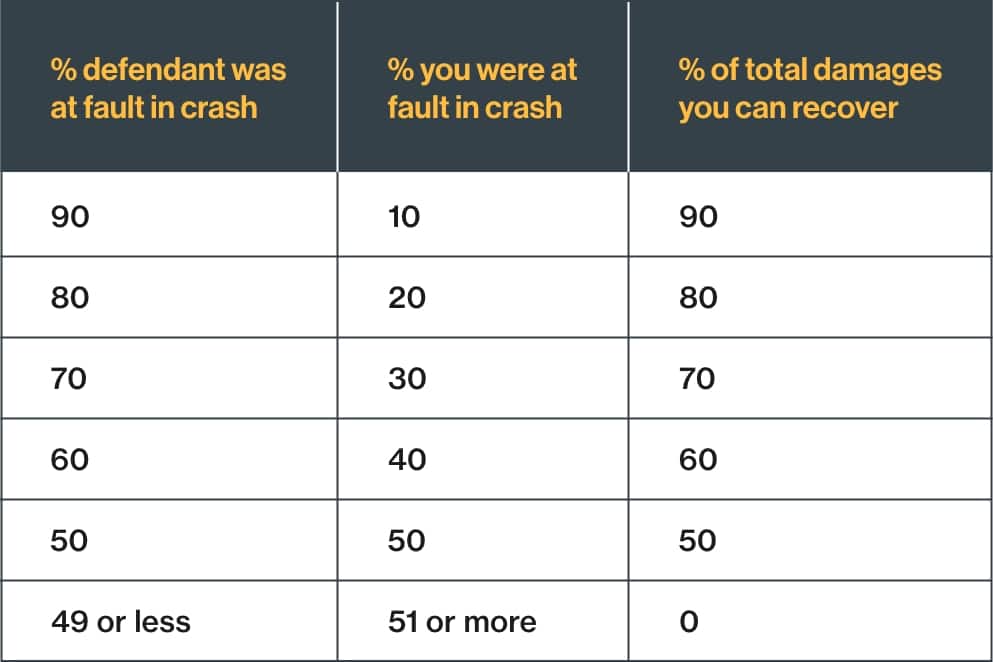

The core idea of comparative negligence is that the more responsibility you bear for contributing to your own injuries in a car accident—or any other type of personal injury claim—the less you can receive in compensation for medical bills and other damages. The percentage of the total damages you lose matches the percentage you were at fault for the incident.

Or, maybe an easier way to think of comparative negligence is: the percentage of the total damages you can receive in a personal injury claim matches the percentage that the OTHER party was at fault.

So, let’s say you have a personal injury claim that could be worth $100,000 in total damages. If the other person was 80 percent at fault (which means you were 20 percent responsible), the most you could recover in compensation is $80,000. If the other person was 60% at fault, your maximum amount is $60,000. And so on.

In a “pure” comparative negligence state, this holds true no matter how much (or little) you’re at fault—so even if you’re 99% responsible, you can still recover 1% of your damages. However, Texas is one of many states that modifies pure comparative negligence in an important way.

Texas’ Rule: Modified Comparative Negligence

Texas negligence laws work the same as comparative negligence for all cases where the other person who injured you (the defendant) is at least 50 percent at fault. But if you were 51 percent at fault or more for causing your injuries, your potential monetary compensation goes down to zero.

Put another way: if you want to file a successful car accident claim in Texas, you and your attorney must prove that the negligent person who injured you in a car crash was at least 50 percent responsible for causing the wreck. If you (the plaintiff) are 51 percent responsible or more, you can’t receive any money at all for your injuries and other losses.

Here’s a table that might make the modified comparative negligence laws in Texas easier to understand.

A table about modified comparative negligence laws in Texas
 

Contributory Negligence

The alternative to comparative negligence is a different rule called contributory negligence. Under pure contributory negligence, an injured party can’t recover compensation if they were even 1 percent at fault for causing their own injuries.

Pure contributory negligence is a very harsh rule, but fortunately, it doesn’t apply to personal injury claims in Texas. So, if you’ve been injured in Texas, just know that if you read about contributory negligence, this rule doesn’t apply in our state and isn’t relevant to your case.

Joint and Several Liability

One question you might be asking is: What if multiple other people were at fault for causing my injuries? In that case, figuring out who must pay for damages may involve Texas’ rules for joint and several liability.

Under joint and several liability, a defendant in a personal injury case who is 51 percent at fault or more for causing your injuries may be jointly and severally liable. If joint and several liability applies, the defendant who is mostly at fault can be held responsible for all the damages you (the plaintiff) are entitled to.

As an example, let’s say Mike and Jennifer both contributed to the crash that injured you. Mike was 60 percent responsible, and Jennifer was 40 percent responsible.

If joint and several liability applies, you could file a personal injury claim against both Mike (who would owe 60 percent of the damages) and Jennifer (who would owe 40 percent). Or, you could file a claim against Mike for 100 percent of the damages.

So, why does this matter? Well, imagine Mike is a millionaire and Jennifer just filed for bankruptcy. Suddenly, the option to file a claim against Mike alone looks a lot better than trying to collect a chunk of your damages from Jennifer, who is broke.

There is also another, much more rare application of joint and several liability that involves criminal acts. If the defendant was engaged in some type of criminal behavior—like murder, sexual assault, or kidnapping—at the time they caused your injuries, then they can be held fully responsible for the damages no matter what percentage they were at fault.

How Will Comparative Negligence Affect My Texas Car Accident Case?

Even if you understand how Texas comparative negligence works, you still may be wondering: “OK, but what does this mean for my case?”

Comparative negligence affects personal injury cases in lots of complicated ways, but there are a few results of comparative negligence that you can almost always expect after a car crash.

The Insurance Company Will Try to Put the Blame on You

Under comparative negligence, the most straightforward way for the insurance company to get out of paying you fair compensation is to blame you for the accident. As soon as you start talking with the insurance adjuster after a car accident, they will begin looking for ways to pin the crash on you.

The adjuster won’t tell you this, of course—they may tell you they are trying to help or are just looking to get “the facts.” In reality, the only facts the adjuster is interested in are the ones that make you look bad. That’s why after a car crash, you should never talk to an insurance adjuster until you’ve spoken with an experienced personal injury attorney and gotten a free case evaluation.

Expect Lots of Arguing Over Who Is at Fault and to What Degree

Even if the insurance company can’t successfully blame the majority of the car crash on you, they can still pay you less if they can show you were partially at fault for the collision. So, the insurance company and their attorneys will dig up and present any evidence they can possibly use against you. The more blame they successfully place on you, the less they have to pay you.

To fight back against these tactics, it’s critical to work with an experienced lawyer. A good Texas personal injury attorney will know all the strategies and arguments that insurance companies use to blame injured victims, and they will be able to gather essential evidence and present compelling arguments to show the truth about how the defendant caused your injuries.

You and Your Attorney Will Have to Prove the Defendant Was at Least 50 Percent at Fault

Since the amount of compensation you’re eligible to receive depends on how much the defendant was at fault, you and your attorney will have to show how the defendant’s actions caused the crash that injured you. And it will be very important to show that the defendant was at least 50 percent at fault — because under Texas’ modified comparative fault rule, if you (the plaintiff) are 51 percent at fault or more, then you have no case.

Texas has very specific rules about what goes into showing that a defendant is at fault and liable. To prove negligence, you and your lawyer will need to show that five legal elements are present in your case:

  1. Duty of care: The defendant had a duty to act (or not act) in a certain way to ensure the safety of those around them. This element is usually the easiest to prove. For example, everyone who drives a car has a duty to drive safely and be free of distractions, intoxication, and other factors that could endanger others on the road.
  2. Breach of duty: The defendant did something—or failed to do something—that violated their duty to look out for others. As an example, a person texting on their cell phone while driving is committing a breach of duty.
  3. Cause in fact: The defendant’s negligence caused your injuries. So, in this example, the defendant’s texting and driving directly caused them to crash into your vehicle and injure you.
  4. Proximate cause: The defendant should have known that their actions could create a danger to others. In the case of texting while driving, most reasonable people know that it’s dangerous thanks to years of public service messaging and stories of distracted-driving crashes.
  5. Damages: You (the plaintiff) suffered actual harm that the legal system can address with monetary compensation. Medical bills for surgery, treatment, and physical therapy after a car crash are an obvious example of damages, although there are many other types of damages—including lost wages, chronic pain, emotional trauma, etc.

Will Adams Law Firm Fights for Injured Accident Victims in Katy, Texas

As a team of attorneys whose families have lived in the Katy, Texas area for generations, we know how important it is to build community. We realize that most people here don’t think of themselves as the “suing type” and may hesitate to file a lawsuit against a neighbor or member of their community. Remember that in most negligence cases, it’s the insurance company who will be paying the damages — not the individual.

You can count on our team of personal injury lawyers to fight for you but also represent you with professionalism and compassion. We’re here to provide the support you need and get you the compensation you deserve.

To schedule your free consultation with a compassionate attorney from our team, call us at (281) 371-6345 or use the easy contact form on our website.

The content provided here is for informational purposes only and should not be construed as legal advice on any subject.

Texas Bicycle Accident Law: A Claimant’s Guide

Bicycle riding is increasingly popular in Texas. Whether you do it to get exercise, save gas money, or reduce pollution, you’re part of a growing and admirable trend in our state.

However, as more and more bicycle riders share the road with motor vehicles, bicycle accidents have also become increasingly common. And without the protection of large, enclosed vehicles, cyclists often endure serious injuries. In 2021, 90 people in Texas lost their lives in bike accidents—up from 79 the year before. Further, a bicycle accident can forever change lives and feelings about riding in the open air.

Anyone who’s been injured by someone else’s actions on the roadway deserves compensation for their losses. However, convincing the insurance companies or a jury isn’t always as easy as one might hope. Fortunately, experienced Katy and Houston bicycle accident lawyers have the knowledge and experience to help injured people secure the money they need.

This article will guide you through that process. We’ll outline the basics of bicycle law in Texas, explain how you can pursue financial compensation for your losses, and flag the things that might complicate your bicycle accident claim. We’ll also discuss how a personal injury lawyer can increase your chances for full and fair compensation.

Overview of Texas Bicycle Laws (Updated for 2026)

Rights and Responsibilities of the Cyclist

In general, bicyclists have the same rights and obligations as motor vehicle drivers. They may use the road and must follow all the same traffic laws and signals. Most cyclists adhere to this, though in some cases they do cause accidents. That said, most bicycle accidents are often the fault of drivers who aren’t properly sharing the road with cyclists. The results could be life-altering injuries or even death.

To minimize this risk, bicyclists are required to:

  • Keep up with traffic when riding in the car lane.
  • Ride as far to the right as possible if moving slower than traffic, unless the lane is too narrow or hazards are in the way. On a one-way street, you may ride on the left.
  • Use appropriate hand signals for stopping and turning left or right.
  • Have working brakes and keep at least one hand on the handlebars.
  • Only have one rider per bike seat.
  • Wear or carry proper reflective gear and lighting. At night, you must have a forward-facing white lamp and a rear-facing red lamp, both visible for at least 500 feet. (A rear-facing red reflector only has to be visible for 300 feet.)
  • Two bikes may ride abreast (next to each other) in the same lane as long as they don’t inhibit the flow of traffic.

Cars are allowed to pass bikes riding on the shoulder or next to the curb as long as they take proper precautions.

Motorist Obligations and the Safe Passing Rule

Beyond the cyclist’s duties, Texas law places specific, measurable responsibilities on motor vehicle operators when bicycles are present. The most crucial safety mandate is the requirement for drivers to maintain a “safe distance” when overtaking or passing a cyclist.

This distance is clearly defined:

  • Standard Passenger Vehicles: Must allow a minimum of three feet between the vehicle and the bicycle operator.
  • Commercial Vehicles and Trucks: Must extend this buffer to six feet due to the increased hazard posed by vehicle size and wind shear.

Failure to adhere to this rule is a breach of the traffic code that often results in catastrophic collisions. When a vehicle violates this required space, the resulting impact can lead to severe and life-altering trauma, including traumatic brain injuries, spinal cord damage, multiple bone fractures, and internal injuries, necessitating extensive medical intervention and long-term care.

Establishing Liability: Modified Comparative Negligence

In the aftermath of such devastating accidents, establishing legal liability becomes necessary to secure recovery for the injured party. Texas utilizes a principle known as “modified comparative negligence,” codified under the state’s proportionate responsibility statute. This law determines compensation based on each party’s degree of fault.

To recover damages, an injured cyclist must demonstrate that the motor vehicle driver’s negligence—their failure to maintain the three-foot passing distance or to yield the right-of-way—was a direct cause of the accident. Crucially, the cyclist’s own assigned fault cannot be greater than 50 percent. If the cyclist is found to be 51 percent or more responsible for the incident (for instance, by riding without required lighting or ignoring a stop sign), they are legally barred from recovering any damages from the driver. If their fault is 50 percent or less, their total compensation amount is reduced in proportion to their percentage of responsibility.

The Role of Legal Practices in Texas Personal Injury Claims

Navigating this proportionate responsibility system is critical, as insurance carriers for the at-fault driver frequently attempt to shift blame onto the cyclist to reduce the compensation they must pay, often relying on minor technical violations of the law. For this reason, individuals harmed in bicycle collisions often seek representation from a legal practice that focuses on accident claims.

These legal representatives assist with investigating the crash scene, gathering evidence, and communicating with insurance companies to ensure the facts align with the statute. Their work centers on proving the extent of the driver’s fault and documenting all resulting losses, which can include hospital bills, physical rehabilitation costs, lost income, and compensation for pain and suffering. The goal is to maximize the financial recovery for the victim so they can focus on their physical recovery while the legal team handles the complexities of the claim process.

Bicycle Accident Liability: Filing a Claim and Negotiations

If cyclists and drivers observe the rules above, the roads are generally safe enough for everyone to ride without issues. However, bike riders are too often injured by the careless actions of those in motor vehicles.

Because Texas is a fault state, someone who causes a crash and injuries is liable for those damages. An injured person begins pursuing compensation by filing a claim with the at-fault party’s insurance company.

Among the damages you may claim are:

  • Medical expenses, including hospital bills, treatment, medications, surgery, therapy, and more
  • Lost wages due to your inability to work after being injured
  • Pain and suffering, including physical discomfort, mental anguish, and missed opportunities

Two bicycle riders on a bike pathWhen you file a bicycle accident claim, do not enter conversations about the incident with an insurance representative. Simply provide the police report and complete necessary forms. Any discussion beyond that puts you at risk of saying something they may try to use against you.

Insurance agents are trained to close claims as quickly and cheaply as possible. If they can get you to even suggest you contributed to the accident, it could impact the entire case. It’s in your best interest not to say anything.

Once you file a claim, the insurance company will respond, most likely with either a denial or a lower offer than you seek in your claim. Never accept a lowball offer, no matter how tempting. It probably won’t come close to what you need for your recovery.

Most people injured in a bike or car accident are not prepared to negotiate effectively with trained insurance representatives. Further, trying to do so can create stress that slows healing and takes time away from your home life. This is why it’s so important to work with an experienced attorney who can take that burden on for you and your family.

Possible Complications for Your Bike Accident Case

Street view of bicycles riding on the roadBeyond negotiations, the circumstances of your case may complicate the process. For example, a significant portion of bicycle accident claims involve a driver who fled the scene. How are you supposed to focus on getting better when you aren’t even sure where to file a claim?

Even if the driver stuck around and provided their information, their insurance policy might be too small to cover your needs, or they might not have any insurance at all. While you can look to your own insurance policies to supplement, an attorney will bring additional insight that keeps the process moving.

Bicycle Rules Vary Across Texas Municipalities

Depending on where your bike accident happened, the local laws might not be what you expect.

For example, while Texas does not have a helmet law, certain cities require riders to wear them. Or consider Houston, where cars must stay at least three feet away from cyclists (six feet for commercial vehicles). Another example is biking on the sidewalk—some municipalities allow it, while others do not.

All of these factors are important to your case. Unless you’re an authority on the various bike laws across Texas, it’s well worth your time to entrust these aspects to a personal injury lawyer.

Texas’ Modified Comparative Fault

Like many other states, Texas observes comparative fault when determining liability. Comparative fault means that more than one person or entity may be at fault for the incident, but injured parties may still recover damages even if they bear some of that fault.

Texas’ comparative fault rule is modified. This means that anyone more than 50% at fault for the incident may not receive any compensation. Further, compensation may be reduced according to your share of the legal responsibility.

For example, imagine you were hit by a car when the driver turned left while you rode through the intersection. Clearly, the driver misjudged their timing. However, if your injuries were worsened because you weren’t wearing a helmet in a municipality that requires them, you may be found, say, 15% at fault.

If full compensation was $100,000, it may be reduced by 15%, leaving you with $85,000.

While it is not illegal for cyclists to have alcohol in their system, being under the influence when injured may affect liability in your case.

Anti-Cyclist Bias

Unfortunately, many drivers, police officers, and potential jurors hold negative stereotypes about bike riders—for example, that they frequently disregard traffic laws and drive recklessly. Many drivers simply do not like sharing the road with bicycles.

This bias can mean that cyclists are less likely to get the benefit of doubt when the facts are unclear, and may be determined to be partially or even completely at fault in cases where they do not deserve it. Working with an experienced attorney can help gather the evidence you’ll need to counter these stereotypes, particularly in tough situations (like when you disagree with the police report).

Bicycle Accident Attorneys Can Help

A cyclist on the phone while standingAs you can see, the potential for complications in your bike accident case are numerous. If your injuries are serious, you and your family could wind up spending countless hours trying to figure out the best path forward, all the while inhibiting physical and mental healing.

Fortunately, experienced personal injury attorneys are ready to take those complexities on. Not only are they great negotiators, but they often work with networks of medical and traffic experts to better understand your case and how to present it to the insurance companies.

For the sake of your health, your finances, and your home life, a bicycle accident lawyer is an invaluable part of your personal injury case.

Will Adams Law Firm Protects Texas Bicyclists

The sooner you contact a personal injury attorney after a bicycle crash, the better. The bike accident lawyers on our team have been part of the Katy community for decades and are ready to do what it takes to help you secure the financial compensation you deserve.

Please don’t hesitate to get in touch with an experienced bicycle accident attorney at Will Adams Law Firm today if you or someone you love has been injured by a driver while riding a bike. You may call (281) 371-6345 or fill in the simple contact form on our website. We look forward to working with and helping you!

References

Laws and regulations FAQ. (n.d.). Texas Department of Transportationhttps://www.txdot.gov/safety/bicycle-pedestrian-safety/laws-regulations-faq.html

Annual Texas motor vehicle crash statistics archive (n.d.). Texas Department of Transportation. https://www.txdot.gov/data-maps/crash-reports-records/motor-vehicle-crash-statistics/archive.html

Should I Sue After a Car Accident?

Individuals and entities get sued for all kinds of reasons in the United States. However, contrary to popular belief, filing a lawsuit is not something one can do on a whim, and it’s not something that only people who are the “suing type” do. It’s actually a specific and, often, necessary process. For someone who’s been injured in a car accident, suing the negligent driver may be the best option—especially in a fault state like Texas.

Yet the reality is that most car accident claims don’t escalate to that level. (And even those that do usually settle before the lawsuit progresses to a jury trial.) Where your case ends up depends on a range of factors, many of which you can’t control.

Understand that suing a person, company, or other entity does not make you greedy or attention-seeking. It simply means you’re using the appropriate and effective means for securing the money you need to get your life “back to normal” after being injured by someone else’s negligence.

This article will outline what exactly a lawsuit is and why many car crash cases never need to involve one. You’ll also learn why car accidents that do turn into lawsuits are justified in doing so. Finally, we’ll discuss why working with an experienced car accident lawyer is vital to the entire process, whether or not it involves a lawsuit.

What Is a Lawsuit?

People standing on the steps of a courthouseA lawsuit is what happens when a personal injury claim or dispute becomes a legal matter within a court of law. It is a formal, defined process that helps bring the dispute toward a conclusion when the parties haven’t yet found a way to come to an agreement.

Before the Lawsuit

After a car accident, the first step toward getting fair compensation is filing a car accident claim with the other driver’s insurance company. The insurance company then investigates the case and determines what kind of settlement offer, if any, to make. If this settlement offer is too low (as it usually is), you or your attorney can attempt to negotiate.

If negotiations break down and you aren’t able to settle your insurance claim at a number that’s reasonable to both sides, the next step would be to file a lawsuit and escalate the dispute to the civil court.

After Filing the Lawsuit

Once you’ve filed your personal injury lawsuit—or in other words, “sued” the negligent driver—the discovery phase of litigation begins.

During this time, both sides examine and share evidence, talk to eyewitnesses and expert witnesses, and prepare their cases for trial. This process can take several months, or even a few years. Do note, however, that the parties are still free to negotiate a settlement at any time right up to the start of trial. As both sides become more familiar with the evidence and each other’s legal arguments, the likelihood of a settlement increases.

If the discovery period concludes and the parties still haven’t settled, they may try to avoid a jury trial by agreeing to mediation or arbitration. However, if these alternatives fall through, the case would go to trial.

Reasons to Consider Suing After a Car Accident in Katy, TX and Surrounding Areas

A man with a leg injury is sitting on a couch while working on a computer

Again, it’s important to note that most car crash cases do not turn into lawsuits. Injured people, their attorneys, and the insurance companies typically manage to reach a settlement during negotiations. This is faster, less risky, and less expensive for everyone involved.

However, car accident lawsuits are not uncommon. The list of reasons to sue includes:

Another driver’s careless or reckless driving caused the accident and your injuries. The costs of your injuries are significant in terms of medical expenses, lost wages, pain and suffering, and other losses. 

The at-fault party’s insurance company is offering significantly less money than you need. (Once you settle, you can’t go back for more compensation later.) Your lawyer believes negotiations have stalled, and suing is the only way forward. 

In Texas, the statute of limitations (how much time you have to file the lawsuit) is two years from the day of the crash. As long as you’re within that time frame, your claim may become a legal dispute in a court of law. Although proceedings will likely continue to involve the at-fault party’s insurance company, it is the person or entity who caused the accident that is being sued.

Again, a lawsuit does not mean your case will go to court for a trial. Judges often encourage various types of dispute resolution, such as mediation and arbitration, to avoid the financial and time demands of a trial.

When the Financial Stakes Are Too High

The most compelling reason to elevate a car accident claim to a lawsuit often comes down to the sheer scale of the financial loss, particularly with catastrophic injuries. If injuries involve complex trauma, permanent disability, or require lifelong medical treatment, a standard negotiation process may not adequately address the full scope of financial needs. The injury claim must account not just for medical bills already incurred, but also for projected costs decades into the future, including specialized equipment, in-home care, and vocational rehabilitation.

Furthermore, Texas law allows recovery for non-economic losses, such as physical pain, mental anguish, and loss of consortium. These subjective damages are often heavily discounted by initial insurance offers. When the gap between the actual, documented cost of recovery and the low offered settlement is massive, engaging capable legal counsel to file litigation becomes a necessary tool to pursue the appropriate compensation to ensure long-term care is covered.

Challenging Disputed Liability

Another frequent trigger for formal litigation arises when liability—who is at fault—is not clear-cut. Texas operates under a modified comparative responsibility rule. Under this law, if an injured party is found to be more than 50% responsible for the accident, they are prohibited from recovering any damages. Insurance adjusters may unjustly attempt to assign partial blame to the injured party in an effort to reduce their own payout, even when evidence suggests the other driver was predominantly responsible.

When an insurer insists on this tactic, filing suit allows your legal counsel to formally challenge their assessment through the litigation process. Once a case enters the court system, both sides engage in “discovery,” compelling the at-fault party and their insurer to produce evidence supporting their version of events. This formal information gathering can clarify disputes over fault that were previously obscured during informal negotiation.

The Litigation Process and Counsel’s Role

Once a lawsuit is filed, the legal practitioners representing your interests shift the focus from informal talks to formal civil procedure. 

This process involves interrogatories (written questions), requests to produce documents, and scheduling depositions (out-of-court sworn testimonies). This rigorous, formal information gathering often forces the defense and their insurer to accurately assess the risk of a trial and may push them toward a fairer settlement.

Firms focusing on personal injury litigation understand that meticulous preparation for trial—even if a trial is ultimately avoided—is the most effective way to secure a reasonable outcome for their clients. 

For an injured person managing their health and recovery, transferring this substantial administrative and legal burden to trusted counsel is one of the primary benefits of initiating litigation. It signals to the opposing side that the injured party is serious about protecting their rights and is prepared to use all available legal avenues to seek a full recovery.

Should I Work With a Personal Injury Lawyer?

A couple meeting with an attorneyLawyers become vital long before a case becomes a lawsuit. Their knowledge, experience, and connections enable them to effectively negotiate with insurance companies. They also know all the places to look for funds, including your own insurance policies. Additionally, their understanding of state law and local ordinances gives them insight most injured people don’t have.

Keep in mind that your life was altered by someone else’s poor decision or inattention. The law provides lawsuits as a way to right the wrong you suffered. As soon as you begin working with a personal injury attorney, you’ll access that system more effectively, because they can:

  • Identify the causes of the crash
  • Pinpoint who contributed to the wreck
  • Argue for the things you need to be restored

Best of all, a lawyer takes on this burden at a time when you need to focus on healing and your family.

But can you afford a good personal injury lawyer? Yes, you can. Almost all Texas personal injury lawyers work on a contingency basis, meaning they only get paid if you secure a settlement or jury award. There’s no financial risk to you.

Lawsuits Are Tools for Complex Cases

A collision with a truck and a carBeyond being a formal legal proceeding, lawsuits are helpful for complicated claims. Often, traffic crash cases are more complex than one at-fault driver and one injured person settling a dispute. With the civil court overseeing your case, you and your lawyer have more leverage for a thorough investigation.

For example, if you were hit by a commercial vehicle, you could end up making claims against the driver and their employer. Sometimes, the driver isn’t even at fault! Mechanical neglect, improper loading, and substandard training can all come into play as reasons for the crash.

Commercial vehicle cases also pull in unique forms of evidence. Semi-trucks might have dash cam footage and “black box” data to review, though getting a hold of it isn’t always easy. Driver log books, employer records, and past infractions (by the individual or company) may be useful but hard to obtain during previous negotiations, and companies can destroy them after a certain amount of time has passed. Lawsuits include a “discovery” phase that allows lawyers to extend their investigations, perhaps accessing evidence they couldn’t before.

Of course, all of this is far simpler if you’re working with an experienced personal injury attorney. They’ll have a sense of how much effort is required, and how it balances with the settlement you’re likely to get. They can also handle up-front investigation and court costs to keep the process moving forward.

Ultimately, your attorney is able to weigh the pros and cons of filing a lawsuit. Sometimes they feel the extra time of a suit isn’t worth the small settlement increase. Other times, they may add a year to the case but secure hundreds of thousands of dollars (or more) for a severely injured person.

You don’t have to make these decisions on your own.

Will Adams Law Firm Holds Wrongdoers Accountable in Katy, Texas

At Will Adams Law Firm, we have a reputation for identifying reckless and negligent parties and holding them accountable. We also ensure the relevant insurance policies are expected to pay out what they owe to injured people.

Our families have lived in the Katy, Texas area for generations. We are dedicated to building and fostering community. We know that most people here don’t think of themselves as the “suing type” and may be hesitant about filing a lawsuit, possibly against someone they know. You can count on us to honor the rule of law and conduct your case aggressively, but also respectfully and professionally. Ultimately, it’s about fairness and justice, and securing the money you need to maintain your livelihood when you are harmed in a car accident that wasn’t your fault.

To learn more about us, or to schedule your free initial consultation, feel free to contact our offices at (281) 371-6345. You may also fill in the easy contact form on our website. We look forward to helping you move forward!

The content provided here is for informational purposes only and should not be construed as legal advice on any subject.

Is Texas a No-Fault State?

If you’ve been in a car accident, the most important thing to do is make sure you and anyone else involved gets to safety and receives medical treatment. But when the dust settles, you might start thinking about insurance claims, and who will pay for the damages.

A man standing between two damaged vehicles while making a phone callThe answer depends on whether you are in a no-fault state or an at-fault state. Texas is a tort state, which means the at-fault driver’s insurance should cover the costs of the accident and medical care (and that the answer to the question in this post’s title is “no.”).

Things can be complicated if fault is difficult to prove or if more than one driver is at fault. A car accident attorney like Will Adams Law Firm can be beneficial for proving who is at fault because they will have experience in knowing what to look for and what proof to provide.


Texas Is a Tort State, Which Mean Texas Is an At-Fault State

A woman reviewing paperwork after a car accidentIf you’re wondering what the difference is between an at-fault state and a no-fault state, we can start by telling you that it’s rather significant.

In a no-fault state, when multiple vehicles are involved in an auto accident, each driver must file a claim with their own insurance company. It doesn’t matter who is at fault. Each driver’s personal coverage should pay out their insurance claims.

A state that uses the tort liability system, like Texas, is a state where the at-fault driver’s car insurance company is responsible for paying the claims related to the accident. This means they are responsible for paying for property damage, medical expenses, lost wages, and pain and suffering, plus the cost of future medical bills or lost earning potential. In a serious accident, these amounts can be substantial, and insurance companies often try to pay out the least they can get away with.

That is why it is always a good idea to speak to a car accident lawyer for a free case evaluation. Having someone like Will Adams Law Firm look at the details of your case and, if you have already received and offer from an insurance company, help you determine how fair that offer is can make a big difference for you.

Comparative Negligence Impacts Who’s Considered an At-Fault Driver

If more than one vehicle is at fault for the car accident, Texas follows the rules of comparative negligence, also known as proportionate responsibility. Basically, this means an injured person making a claim (the plaintiff) may see their compensation reduced if they bear some fault for the accident.

For example, if you’ve made a claim against another driver (the defendant) and they are found to be 60% at fault for the accident, then their insurance coverage is responsible for 60% of the total amount of damages. Looking at this another way, your compensation is then reduced by 40% (your percentage of fault).

Texas uses modified comparative negligence. This means that if you were more than 50% at fault, you have no right to receive compensation from the other driver’s insurance.

Comparative negligence defense is a tactic auto insurance companies might lean on to avoid paying fair compensation. If they can prove that you are partially responsible for the accident, they can then reduce the amount they’re responsible for paying.

If there is any question of fault, a skilled car accident attorney can help prove the facts of the accident. Having an experienced lawyer fight for you can give you the peace of mind you need while you recover from an accident. Don’t let the insurance companies push you around!

How an Auto Insurance Company Pays for Car Accidents

An attorney and a client signing papersIf you’ve been in an accident, and you are not at fault, you need to get the other driver’s insurance information. Then you can file a claim with the insurance company of the at-fault party.

Every driver in Texas is required to have minimum coverage. We often call this 30/60/25 insurance, because the minimum liability limits are:

  • $30,000 for bodily injury insurance (per person)
  • $60,000 total per accident
  • $25,000 for property damage

When you file a claim with the at-fault driver’s car insurance company, they may only pay out to these limits. In a serious accident, medical bills can easily exceed $30,000. What happens if the other driver’s insurance is not enough to cover your medical expenses, or if the other driver does not have any insurance?

Car accident insurance claims can get complicated. One option is to sue the other driver, but if they only have the minimum liability coverage or no insurance at all, they probably do not have enough money in the bank to cover your bills.

One possibility here is that you may be able to recover the remainder of your bills with your own insurance. If you have uninsured or underinsured motorist coverage (UM/UIM), that is designed to protect you in this scenario.

Another supplemental insurance option is your own personal injury protection (PIP) insurance. MedPay is another type of insurance that may cover medical bills for you and your passengers.

Will Adams Law Has Helped Thousands of People Like You

An attorney shaking hands with a coupleAt Will Adams Law Firm, our staff has over 25 years of experience in defending the rights of people like you. We talk to auto accident victims daily to learn about the selfish and distracted drivers that put them in harm’s way. If you are struggling to find justice as the victim of a car accident, take advantage of our free consultation to tell us your story and let us see how we can help you receive the fair treatment you deserve.

Our firm knows the challenges of inadequate liability insurance, and how that can leave car accident victims floundering financially. We have in-depth experience investigating other insurance policies that can help you get back on your feet. We work hard so that the people in our community and state don’t have to feel like they are fighting giants alone!

Schedule Your Free Consultation Today

We offer a free, no-strings-attached consultation so that you can tell us about your car accident and insurance claim, and we can walk you through your legal options. We’ll work with you, make sure you understand every step of the legal process, and empower you to make the best choices for your future.

Katy is our hometown, and we’re deeply committed to nurturing every attorney-client relationship. When an accident occurs, not only do we hold the at-fault driver accountable; we strive to treat the injured parties as we’d treat members of our own family.

To get started, call our office at 1-800-559-0593, or fill out our online contact form. We’ll get your free evaluation scheduled so you can focus on healing and stop worrying about the red tape.

The content provided here is for informational purposes only and should not be construed as legal advice on any subject.

What Is the Average Settlement for Shoulder Injury After a Car Accident?

Your shoulder performs many functions that impact your daily life. What would your life look like if you lost the use of one arm? If you’ve been in a car accident and experienced a shoulder injury, you may have already asked yourself this question as you try to recover. It is scary to think about never regaining the use of your arm, especially if the cost of medical bills is preventing you from seeking help from a doctor.

A close-up of a person with a shoulder injuryIf you experienced injuries after a car accident caused by a negligent driver, make sure you get all the medical attention you need. Shoulder injuries, such as a rotator cuff tear, are common during vehicle collisions and can be slow to heal.

You can pursue the negligent party’s insurance for compensation following the accident, and recover money for your medical bills, lost wages, pain, suffering, and more. A skilled car accident lawyer can help you make sure you get the fair settlement you are entitled to for your shoulder injury. Here at Will Adams Law Firm, our settlement results speak for themselves. We’ve helped our clients find peace in their recovery, as we compassionately take on their fight with the insurance companies.

Common Shoulder Injuries From Car Accidents in Texas

A man with a shoulder injury seeing a doctor or therapistYour shoulder is one of the weaker joints in your body, which makes it more likely to suffer an injury. During a car accident, you may experience unexpected high forces on your muscles, tendons, ligaments, and bones, which can cause these important parts to strain, tear, fracture, or break.

Most people tense up during a car accident, and if you are holding a steering wheel, your whole arm may stiffen up and cause all the force of the car accident to be absorbed by your shoulder. Depending on the severity of the collision, you may experience any of these injuries:

  • Broken Bones. With a strong impact, you may experience fractured or broken bones, such as a broken clavicle.
  • Shoulder Dislocation. Due to the structure of the shoulder joint, a dislocated shoulder is a common injury.
  • Rotator Cuff Injury. The rotator cuff muscles and tendons support the shoulder joint, and during a car accident the forces involved can tear these tissues. This injury can cause severe shoulder pain.
  • Soft Tissue Trauma. Other soft tissues near the shoulder joint can also suffer if they are impacted.
  • Whiplash occurs when your head snaps back and forth. Severe whiplash can injure muscles in the neck as well as the shoulder.

Following an accident, you may feel shooting pain in your shoulder or arm. There may be stiffness and loss of joint mobility. Serious injuries can cause lumps or depressions around the shoulder due to swelling or tears. These injuries may require anything from physical therapy to invasive shoulder surgery.

A thorough medical diagnosis is critical to correctly identifying your shoulder injury, and it’s very important to follow your doctor’s prescribed treatment plan, including physical therapy, as closely as you can. By doing these things, you will have a stronger case when you are pursuing a shoulder injury claim. Insurance companies do not want to pay out, and they may try to argue that your shoulder injuries are not serious or were not caused by the accident. A doctor’s testimony can be very valuable when you are seeking a fair settlement.

Factors That Influence Shoulder Injury Settlement Amount in Katy, TX and Surrounding Areas

A shoulder injury, often resulting from motor vehicle accidents, slip-and-fall incidents, or workplace mishaps prevalent in and around Katy, TX, can be a life-altering event. The subsequent legal claim for compensation is a complex process where numerous specific factors intertwine to determine the final settlement amount. While the principle remains: more severe accidents often lead to more serious injuries, the true complexity lies in quantifying the total financial, physical, and emotional burden the injury imposes on the victim’s life.

In general, combining an increased severity of an injury with its demonstrable, longer-lasting impact on a person’s ability to function and enjoy life can potentially result in a considerably higher settlement. Because every injury is unique, it is impossible to predict the precise value of any specific case without a thorough review by legal counsel.

However, certain statistics can offer a general baseline. While many shoulder injury cases settle for lower amounts, the average payout often cited is in the range of $100,000. It is crucial to remember this figure is an average, encompassing minor cases and those involving catastrophic, million-dollar-plus resolutions where the injury leads to total disability or permanent impairment. Understanding the specific components of your case is the only way to seek fair compensation.

Here is an in-depth look at the major factors that influence the total amount of a shoulder injury settlement:

1. Medical Bills and Treatment Documentation

The foundation of any personal injury claim is the documented cost of necessary medical care. These expenses must be directly traceable to the accident. Given the complexity of the shoulder joint—which involves the rotator cuff, labrum, and various tendons and ligaments—treatment can range from conservative management to major surgical interventions.

Current Medical Costs: This category includes all bills for medically necessary procedures immediately following the accident up to the time of settlement.

  • Diagnostics: Costs associated with initial assessments, including X-rays, Computed Tomography (CT) scans, and Magnetic Resonance Imaging (MRIs). The severity and type of injury often revealed by an MRI (e.g., a full-thickness rotator cuff tear versus a partial tear) are critical to valuation.
  • Non-Surgical Treatments: Expenses for conservative approaches, such as physical therapy sessions, chiropractor visits, various pain medications, and steroid or cortisone injections designed to reduce inflammation and manage pain. The duration and frequency of these therapies signal the injury’s recalcitrance.
  • Surgical Intervention: If surgery is required, the costs escalate significantly. This includes facility fees, anesthesiologist fees, and surgeon fees for procedures like invasive rotator cuff tear surgery, labral repair, or less invasive arthroscopic surgery. The necessity of repeat surgeries further increases the claim’s value.

2. Future Medical Needs: The Long-Term Projection

If the treatment for the shoulder injury is ongoing, or if the injury is determined to have a permanent effect, a significant portion of the settlement amount is allocated to Future Medical Needs.

Calculating this value requires more than simple estimation; it necessitates a detailed analysis of the victim’s likely medical trajectory. A legal team accustomed to handling these claims will frequently consult with medical professionals to project necessary care over the victim’s expected lifespan. This may include:

  • Ongoing Physical Therapy: Calculating the cost of continued sessions over several years to maintain mobility.
  • Medication Management: Estimating long-term prescription costs for pain or nerve management.
  • Hardware Removal or Replacement: If the victim underwent surgery requiring plates, screws, or anchors, the potential cost of a future procedure to remove or replace that hardware must be considered.
  • Future Joint Replacement: For severe injuries, especially those leading to post-traumatic arthritis, the eventual need for a total shoulder replacement (arthroplasty) must be included, factoring in inflation and the cost of the surgical event itself.

3. Economic Damages: Lost Income and Earnings Capacity

These damages are quantifiable losses directly tied to the victim’s professional life.

Lost Wages: This covers the time the victim missed work directly because of the accident, initial hospitalization, mandatory medical appointments, and recovery from surgery. The documentation for this is straightforward, involving pay stubs, W-2 forms, and employer statements confirming missed shifts and corresponding financial loss.

Lost Earning Capacity (LEC): This is one of the most critical factors influencing large settlements. LEC accounts for the life-long impact that the shoulder injury has on the victim’s ability to earn money. This often applies when:

  • Career Change is Forced: A job requiring heavy overhead lifting (e.g., construction, mechanic, professional athlete) may become physically impossible due to chronic pain or mobility restrictions.
  • Reduced Work Hours: The injury prevents the victim from working full-time or accepting overtime, leading to a permanent reduction in their annual income.
  • Diminished Promotion Potential: The physical limitation impacts the ability to advance in a career path.

To calculate LEC accurately, legal teams frequently utilize the assistance of forensic economists and vocational rehabilitation specialists. These professionals analyze the victim’s education, work history, and potential career path before the injury, comparing it to their projected income after the injury, presenting a comprehensive monetary figure for the lost potential.

4. Non-Economic Damages: Pain, Suffering, and Quality of Life

Often referred to as “Pain and Suffering,” non-economic damages are compensation for the non-monetary losses associated with the injury. Shoulder injuries can severely impact one’s quality of life, either temporarily during recovery or permanently.

The value assigned here is subjective but based heavily on objective documentation.

  • Physical Pain and Discomfort: The actual physical suffering endured.
  • Loss of Consortium/Companionship: The impact on marital or familial relationships due to physical limitations or psychological changes.
  • Emotional Distress: Including anxiety, depression, and stress related to the injury, treatment, and financial strain.
  • Loss of Enjoyment of Life: This is highly influential in Katy, TX, where an active lifestyle is common. If the victim was an avid basketball player, a dedicated pianist, a keen golfer, or simply unable to lift their infant child, the demonstrable inability to engage in these valued hobbies and activities factors heavily into the settlement amount. Documentation often involves journal entries, witness statements, and therapist reports detailing the daily struggles and emotional toll of the injury.

Insurance companies typically use a “multiplier method” (1.5 to 5 times the total economic damages) or a “per diem” (daily rate) calculation to arrive at an initial figure for non-economic damages, but a capable legal representative will argue for a higher valuation based on the specific, profound impact on the victim’s life.

5. Liability and the Role of Comparative Fault in Texas

The settlement amount is also fundamentally controlled by the question of liability—who was at fault for the accident. Texas operates under a Modified Comparative Fault rule, also known as proportionate responsibility.

Under this rule, a victim can recover damages only if they are determined to be 50% or less responsible for the accident. If found 51% or more at fault, they recover nothing. If, for instance, a court determines the victim was 20% at fault for the incident, their total calculated damages will be reduced by 20%. A legal practice must thoroughly investigate the accident scene, secure witness testimony, and review accident reports to establish and protect the victim’s minimal responsibility, maximizing the potential recovery.

6. Property Damages

While often smaller than medical or lost income claims, damage to property must be factored in. This includes the cost of repairing or replacing the vehicle involved in the accident, as well as any personal items inside the car (laptops, phones, musical instruments) that may have been broken or damaged during the collision.

7. Punitive Damages (Rare Circumstances)

Punitive damages are distinct from compensatory damages (which cover medical bills and pain and suffering). They are rarely awarded and only in cases involving gross negligence or extreme recklessness. These damages are not intended to compensate the victim but rather to punish the defendant and discourage others from engaging in similarly dangerous conduct. Examples include cases involving drunk driving (driving while intoxicated, or DWI) or intentional acts of harm.

Who Pays for My Shoulder Injury Settlement in Katy, TX?

A man on the phone with a lawyerIf you were a passenger in the vehicle of a friend or family member, you may be hesitant to seek a shoulder injury case against someone who is important to you. However, it is not your friend or loved one who will pay for your bills. It is their insurance company – most likely their auto policy, but there are other insurance companies that may cover the settlement.

For instance, drivers are required to have minimum insurance in Texas. That insurance will typically cover your claims. However, if the value of the claim exceeds their coverage, or if the negligent driver is not insured, there are other options. If you have Under Insured Motorist (UIM) or Uninsured Motorist (UM) coverage, that may cover all or a portion of your shoulder injury claim.

Your car accident lawyer might start digging through the facts and find out that the other driver was on the clock when the accident occurred. If that is the case, the employer’s insurance will likely cover your claim.

With the help of a lawyer like Will Adams, you can be sure that you have someone on your side who will explore all the possibilities of different insurance companies that may be able to compensate you for your shoulder pain or rotator cuff injury. Shoulder surgery is a serious procedure, and we know you need to spend as much time as you can recovering, not worrying about how you are going to pay your bills.

For Shoulder Injuries in Katy, TX and Surrounding Areas, Please Contact Will Adams Law Firm

We’re active members of the Katy community, and when one of our own gets hurt, we want to help. If you, or someone you love, has shoulder pain following a car accident, don’t face this struggle alone. Will Adams Law Firm is ready to put in the hard work to help you recover and get the compensation you deserve.

We offer free consultations to discuss the details of your case and get a better idea of what settlement you can expect from your shoulder injury lawsuit. To request a personal consultation with one of our skilled personal injury attorneys, call our office at 1-800-559-0593 or fill out our simple online contact form.

The content provided here is for informational purposes only and should not be construed as legal advice on any subject.